Showing posts with label Mammoth Cave NP. Show all posts

Thursday, August 9, 2018

Search and Rescue on the Green River


I started the last week of July by responding with Ranger Russell and Ranger Jaynes to a potential cave search and rescue. We received a call about a visitor passing out while on the wild cave tour. We loaded the stair chair into the truck and I followed the rangers to the elevator. Thankfully, with assistance, the visitor managed to make it to the surface by the time we arrived on scene. It was great news that the visitor had made it to the halfway point of the tour, because any search and rescue efforts deeper into the cave would have been extraordinarily difficult. The visitor refused medical transport and I transported him back to the visitors center.


Later in the day I also assisted with an abandoned vehicle. While on patrol Ranger Russell noticed an abandoned vehicle and trailer parked on the side of the road. I gathered traffic cones and put them out along the roadside to warn motorists of the truck parked along the curve. Later, I returned to the area to check the status of the vehicle. The owners had returned and driven off, which took care of the problem.
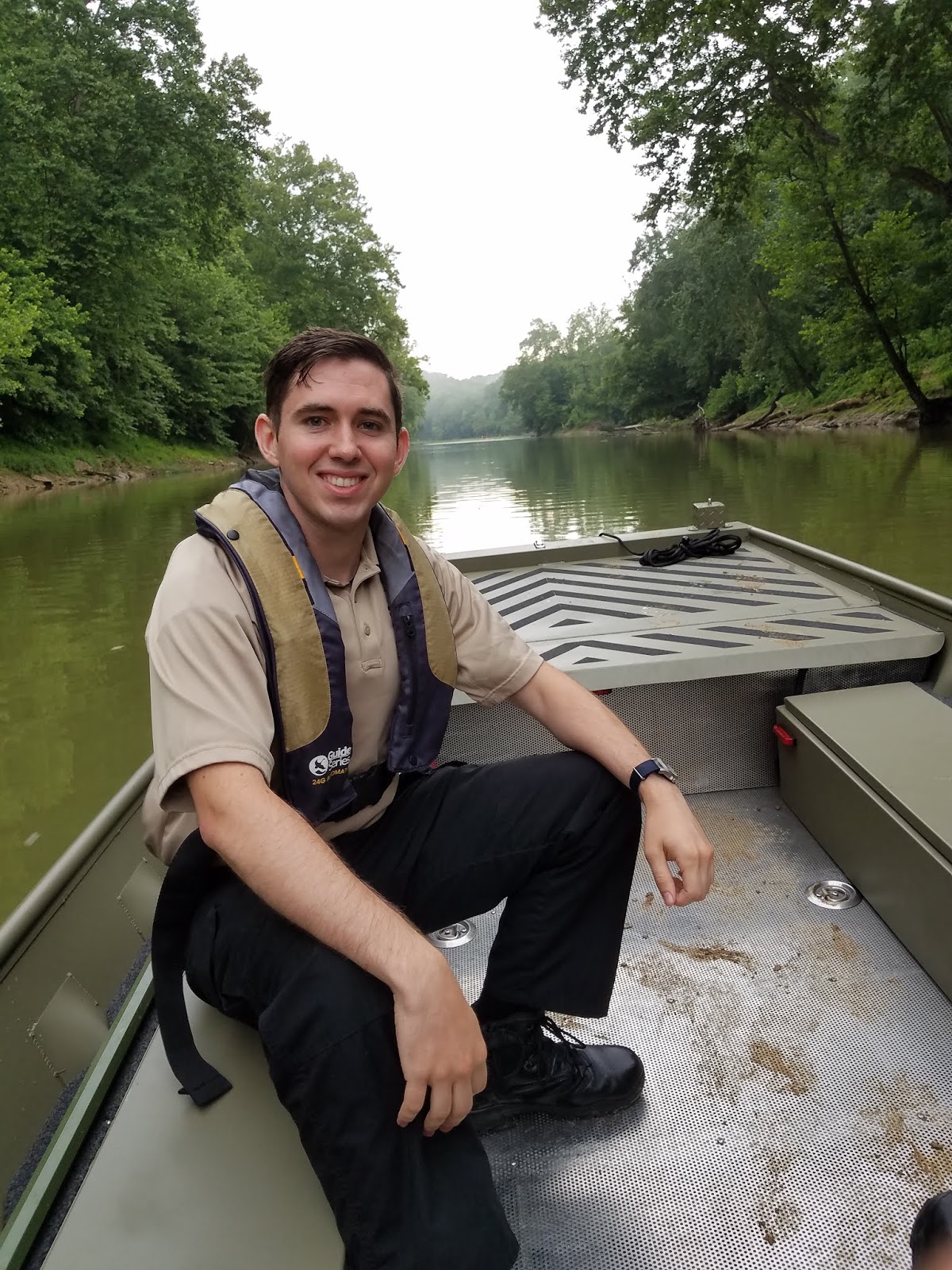
The next day I rode along with Ranger Clemons as he ran RADAR in the park. I learned more about how to use RADAR and I got the chance to try and use the unit myself. I also learned more about what to look for while running RADAR, including possible signs of someone driving under the influence. As the day came to a close, we got the call that several people in canoes and kayaks had capsized and were trapped in a strainer. Ranger Clemons, Ranger Sacia, and I launched the rescue boat and went up river in search of the canoers. We found three people on a sunken tree trunk in the middle of a fast moving current and two others similarly trapped. We secured the group of two people first, and towed them over to shallow, slow moving water, where they could safely stand and walk. Next, Ranger Clemons and Ranger Sacia removed the people on the tree trunk, one at a time, while I stood further downstream with a throwbag ready lest anyone be carried downstream. Once everyone was safe and out of the water, we transported them down to the Green River Ferry. Then, we went in search of the capsized canoes. One was pinned in a strainer, and the other was capsized further downstream. We put our swift water rescue skills to the test and thankfully everyone made it off of the river safely.

The next two days were dedicated to my program visit, but that is deserving of its own post -- and I don't have fast enough internet to download and upload the pictures from the visit at this moment.

Sunday, August 5, 2018

My Place In Mammoth Cave: The Historic Entrance


My favorite view in Mammoth Cave National Park is from the inside of the historic entrance. The historic, natural entrance to Mammoth Cave is a spectacle to see and experience. As you approach the entrance, the temperature noticeably drops and you can feel the cave "breathe," expelling cold, damp, 50 degree air. Water drips down from its roof and natural lighting quickly gives way to darkness. While Mammoth Cave is a sight to see, but the entrance is special. It is your first sight of the cave system and the portal to that dark, subterranean world.

Thursday, August 2, 2018

The Wild Dog and The Wild Cave (Tour)

Here at Mammoth Cave the third week of July really flew by! I started my week by reporting to the visitor center to pick up a ticket for the wild cave tour. While I have been able to go on several of the park's cave tours, the wild cave tour is the closest thing to cave exploration that the park offers. The tour is five hours long, unlit, save for your headlamp, and includes stretches of cave that require you to crouch, crawl, canyon walk, and climb! I knew I wanted to go on this tour the moment I went on my first cave tour, and I had a great time!
 I arrived early and got to know the rangers that would be leading the program. Once the visitors arrived, we took a short bus trip to the camp store, where we were equipped with coveralls, cave helmets, headlamps, gloves, and bags. Once we were outfitted, we re-boarded the bus and finished the trip to the cave entrance. The tour began with a long, steep staircase leading down into the cave. From there we began walking through a large passage. We stopped, and the guides announced that we would be starting the first crawling portion of the tour. While I was excited about this, I was a little confused because I did not see any cave passages. Of course, I had seen the crack in side of the cave passage that we were about to go into, but I had certainly not considered the fact that it might lead someplace. One by one, we crawled in, and the real adventure began.

For five hours we crawled, walked, climbed, and navigated our way through obstacles and features with names like sewer pipe, double barreled shotgun, and the compass needle. During the tour, I also checked the condition of the first aid kits cached along the route. Needless to say, any rescue operations in this portion of the cave would be extremely difficult, and exploring this portion of the cave was a great learning experience.


Inside the snowball dining room
The next day I got to run a driving course and I practiced backing up around obstacles. Most of the vehicles used by law enforcement here do not have good rear visibility because of the cage dividers and equipment stored in the trunk, so having these skills is essential. I also helped Ranger Johnston find tools and equipment to install a safety chain on the new boat trailer. 

Sunday proved to be a busy day in its own right. In the morning, I received a lesson on report writing using IMARS and I helped enter several reports. I also assisted the rangers with a car lockout near one of the hiking trails. I used a pump wedge and a long arm auto opening tool to reach inside of the locked vehicle and successfully unlock it! In the afternoon I rode along to an EMS call outside of the visitors center. All of the law enforcement rangers here are certified EMT's, as are several of the interpretative rangers. Watching them in action only confirmed my decision to take an EMT course once I graduate. Later, we responded to a call reporting a sighting of a stray dog within the park. We saw the dog, however, we were unable to capture it, and it ran away. This dog would keep me busy over the next two days as I tried to catch it, and then was sent to pick up a trap to capture it. In the evening I reviewed Fourth Amendment case law related to use of force, including Graham v. Connor and Tennessee v. Garner.

My Monday began with a surprise appearance of the lost dog outside of my seasonal housing. I grabbed a package of hot dogs and tried to lure him to the ranger station. He was hungry, and more than willing to follow me. I was even able to pet him, however, he was wary of being captured, and he ran away once he saw National Park Service uniforms. After my unsuccessful attempt, I reported in to the ranger station. I reviewed use of force with Ranger Clemons and then prepared for a series of use of force scenarios. In each scenario, I approached a suspect and asked for ID. In most cases, the suspect then became confrontational, aggressive, and pulled out a weapon. In each situation I needed to respond with an appropriate level of force. While the scenarios were stressful and I was still learning where all of the tools were on my belt, I learned a lot about use of force!


On Tuesday I took a road trip down to the Kentucky state line to meet a ranger from Fort Donelson. I needed to pick up an animal trap and bring it back to Mammoth Cave so we had a chance at catching the stray dog. While it was a long drive, the countryside was beautiful and it was a nice chance to see more of Kentucky.
Road trip!
The trap, delivered to the ranger station


Wednesday, August 1, 2018

Exploring the Park (and more!)

The second week of July was exciting and gave me the opportunity to explore a lot more of the park!
I spent my weekend exploring the park's back country, hiking down from the Lincoln trail head to the Turn Hole Bend campsite, where I spent the night before hiking back the next morning. It was nice to be able to recreate in the park and learn more about the parks resources.

My hiking route for the weekend

The view from my campsite
After returning from the back country, I started my week by riding along with Ranger Russell. We patrolled the ferry parking lot and looked into cars for signs of alcohol use on the river. I also learned more about the issue of ginseng poaching within the park. Hunting for wild ginseng is popular in the area, given the root's value in traditional medicine. However, harvesting ginseng within the park is illegal, and arrests have been made in the past due to the illicit trade. Continuing the spirit of resource protection, I also helped investigate reports of a deer carcass on the river the following day. Kayakers had reported seeing a dead ten point buck on the river bank, and we went out to investigate. The site ended up being too difficult to reach on foot, so we launched a boat and went downstream to take a closer look.
Trying to spot the carcass from the riverbank
Given the purported size of the buck the rangers wanted to inspect the carcass for signs of poaching. When we discovered it, however, we found the carcass was much smaller than reported and its hide too badly decomposed to investigate.


The following day I  accompanied rangers sent to investigate a damaged lock on an old, unused  entrance. The lock was replaced, and while we were out there, we took a look inside of the cave. It was awesome to be able to take a look behind the scenes and explore yet another cave! 
The old cave entrance
Climbing down into darkness

Look at those formations!

I finished out my week by tackling another project: completing an inventory of the park's hasty packs. As the name implies, these hasty packs are filled with all of the equipment needed for a HASTY team in a search and rescue operation. A number of these bags are kept stocked with the search and rescue equipment, and each bag is filled with maps, basic navigational equipment, flashlights, first aid kits, PPE (Personal Protective Equipment), and any other items rescuers might need. I created a new item checklist and collected the items and PPE missing from each bag.

The contents of a hasty pack

Tuesday, July 24, 2018

You Drink, You Drive, You Lose: Sobriety Checkpoints at Mammoth Cave

I started the first week of July here at Mammoth Cave by completing an inventory of the park's search and rescue equipment. After the inventory was completed, I got to take the park's UTV training. After studying the written standard operating procedures and completing a short exam, I got to take the UTV for a test drive, driving it on the road as well as off road. 


Later in the week, I went on a ride along and I was able to sit in on a traffic stop that resulted in an arrest for an outstanding warrant. While the initial stop was for reckless driving, it turned out that the driver had failed to pay court fines and a bench warrant had been issued for his arrest in a nearby county. Once he was arrested, the rangers transported him to the county line, where he was turned over to local law enforcement.

The most significant event of the week, of course, was the law enforcement division's preparations for the Fourth of July. On the third and fourth, the law enforcement division ran sobriety checkpoints within the park in order to prevent drunk driving. I helped prepare for the checkpoints by collecting the signs, cones, spotlights, and drug testing kits needed for the operation. I also was able to change my schedule and work the nights that the checkpoints were run. In the DUI checkpoints, vehicles were briefly stopped and inspected by the law enforcement rangers. Rangers checked drivers' licenses and vehicle registrations, and if all was well, sent the cars on their way. On the checkpoint I was put to work recording vehicle violations, license plate numbers, and the number of vehicles passing through the checkpoint. However, if there were any signs of drugs or alcohol in the vehicle or if the driver appeared to be under the influence, the car would be pulled over, the vehicle potentially searched and the driver given a field sobriety test. Of course, some drivers attempted to evade the checkpoint. However, if the vehicle violated traffic laws in the process, for example, by making an illegal u-turn, running a stop sign, or failing to signal, it could be pulled over on a traffic stop. 

The checkpoints were a success, and both nights ended in arrests for driving under the influence. It was a great experience being able to help out and I learned a lot about stops, vehicle searches, and field sobriety testing by watching the park rangers and local law enforcement carry out their duties. 
Waiting for vehicles to arrive at the checkpoint

Recording plate numbers and violations
I finished out my week by learning more about IMARS, the Incident Management Analysis and Reporting System. The system is used by the Department of the Interior to file and manage law enforcement information and of course, file reports. I also visited dispatch and got to watch the dispatcher manage radio calls from different agencies as well as 911 calls.


Thursday, July 19, 2018

Getting Organized

After completing the swift water rescue training course, a lot of work needed to be completed to put the training into effect. First, the rangers needed to acquire the equipment needed to safely perform these rescues, and, second and third, that equipment needed to be inventoried and distributed to the rangers. In the beginning of my third week at Mammoth Cave, I helped with these efforts, sorting and cataloging new rescue gear including PFD’s (personal flotation devices, life jackets,) wet suits, ropes, carabiners, as well as more specialized equipment such as a line throwing system.

A new fire extinguisher and rope cleats

I also got to help work on the new patrol boat, installing rope cleats on the hull and mounting a fire extinguisher onboard.
inside the SAR trailer

The most time intensive project of the week, however, was inventorying the contents of the park’s search and rescue (SAR) trailer. Nearly everything that the rangers might need for a search and rescue, including litters, backboards, high angle rescue equipment, swift water rescue gear, and even equipment needed to transport a patient by helicopter, is kept loaded in the SAR trailer so that it may be accessible in an emergency at a moment’s notice.

Inventory on the SAR
Trailer


I went through all of the trailer’s contents and created an inventory of everything onboard, recording each item’s description, issue date, quantity, and location. As I sorted through all of the ropes, harnesses, climbing systems, and other gear, I learned a lot about search and rescue equipment, and more importantly, I made a system that might make it easier to organize everything or find a piece of equipment during an emergency.


In the middle of the inventory, I got to ride along with Ranger Clemons as he investigated a call that marijuana had been found in the Visitor’s Center. Just to prove the expression that when it rains, it pours, immediately after concluding the investigation, the skies opened up, and the downpour caused several problems. Due to the heavy rain, a tree fell and blocked a road outside of the park, while another fell onto one of the Green River Ferry’s cables, rendering it unsafe to operate. While trail crews began to clear the fallen tree from the cable, we learned that there were a number of visitors out on the water in canoes and kayaks when the storm hit. The Green River turned brown due to all of the top load, and the current became noticeably faster. We found out that the boaters were late, and should have already made it down to the ferry.

Preparing for a search and rescue on the river

As we waited for the visitors to float down the river, we readied the boat for a search and rescue operation gear in the event that any boaters were missing. Thankfully by the time we returned to the ferry and prepared to launch, the first group of kayakers arrived, soaking wet, but safe.

Monday, July 16, 2018

Adventures on the Green River

After everything that I got to do in my first week here at Mammoth Cave National Park, the second week had some high standards to meet. I am happy to say my second week exceeded all expectations. On my first day, I helped Ranger Johnston catalog and reorganize evidence in evidence storage. Each confiscated item was bagged in an evidence bag and was identified by an inventory number and bar code. In many ways, this process was similar to that of inventorying a museum catalog like I did at Gettysburg NMP last Summer. After helping with the reorganization, I was sent with another intern to bring an ax, splitting wedges, and a chainsaw to two rangers who were on the river.

Ranger Russell using his chainsaw on the river.
Not pictured: me getting sprayed with water and wood chips.

We met the rangers at the ferry ramp and accompanied them on their boat as they worked to cut up fallen trees on the Green River. Due to a drop in the water levels on the river several years ago, many of the trees along the river bank became unstable. Trees submerged in the river can present a safety hazard to boats and kayaks and they must be removed.


The following day I got to spend even more time on the river on boat patrol with Ranger Sanders and Ranger Russell as they finished cutting a fallen tree and installed mile markers on the river. A marker is placed on the river for every mile within the park boundary. These mile markers can help in the event of an emergency, as well as for ease of navigation on the river. A GPS unit was used to measure the mile increments, and I got to help bolt the new signs to trees along the river banks.

New mile markers awaiting placement
After helping install the new mile markers, my day took an unexpected turn as we were called in to respond to a cave rescue. Mammoth Cave offers a variety of cave tours to visitors. While guides warn visitors that these tours can be strenuous or even hazardous if you are in poor physical shape, elderly, or have health problems, there is still the need for emergency extractions. In most cases, this will not be pleasant for anyone involved. If the patient is unable to walk, he or she will typically be strapped into a stair chair and pulled or dragged down narrow, often uneven cave passageways by the emergency responders. Given the remote locations of the cave entrances as well as the fact that the patient is 300 feet underground, this process can take hours. Thankfully, in this case, the patient was able to walk out of the cave with some assistance and the rescue only took about three hours from beginning to end.

On the third day, I assisted with a car lockout in the visitor center parking lot. I had prior experience with using lockout kits, however, the car's newer security system put up a strong fight. In the half hour that we were out there, I learned quite a bit about unlocking cars and learned that an unshaded parking lot in the heat of the day is comparable in temperature to the surface of the sun. Later that day, I also finished putting together the new EMS kit, and helped cut a anchor line for the new boat.

I was lucky enough to spend the next three days sitting in on a swift water rescue course with the rest of the law enforcement rangers! We spent the first day of the training in the classroom, gaining practical information about swift water rescue and how to survive in swift water. We learned about a variety of river hazards, both natural and man-made, studied basic hydrology, watched and analyzed videos of real swift water rescue incidents, and finished the day practicing knot tying and learning to accurately throw throwbags.


On the second day of the training we took boats to one of the islands in the channel of the Green River in order to get hands on experience with swift water. We learned how to properly swim and how to properly float and navigate in a current. From there, we practiced throwing and catching ropes in swift water as well as how to tie onto a line and safely retrieve someone from the water. We also got to experience various river obstacles, and learned how to overcome them.


On the last day of our training we continued with more practical training. We learned how to paddle and operate rubber rescue boat, multiple ways to right a capsized one, and how to safely pull the rest of the crew aboard. By the end of the course, I felt I had learned a lot about swift water rescue, and perhaps just as importantly, a newfound respect for the power of moving water.


Starting out with a Bang


My first week at Mammoth Cave National Park started out the best way that it could have, on the range. It just to so happened that my first day coincided with the rangers' firearms refresher. Before heading out, I was outfitted with a duty belt and I was taught shooting stance, grip, how to draw from a retention holster, and how to perform a tactical reload. While I could not use a real firearm at the range, I was able to use a SIG P229 chambered to fire simunition rounds, and I got to stand with all of the rangers in the firing line and run through a variety of shooting drills with them. The rangers practiced firing from a variety of stances and positions: standing, kneeling, prone, behind cover, on their backs, as well as shooting one handed and with their non dominant hands. I also learned how to draw my weapon as well as perform reloads one-handed and with just my non dominant hand. Practicing shooting skills is essential for officer safety, and the variety of the training reflected some of the possible hazards or situations a Park Ranger might find himself in. One of the more intense drills was a series of tourniquet drills. Every law enforcement Ranger carries a tourniquet on his duty belt, and while hopefully they will never need to be used, practicing applying them while under duress could be life-saving. During these drills, each ranger would fire at a target until he was told he was "hit,"  after which the afflicted limb would be incapacitated and a tourniquet would be required to stop the continued application of fake blood to that limb from a spray bottle. Once the tourniquet was in place and cinched, the shooter would perform a tactical reload, often one handed, and fire two additional rounds at the target. This drill was intense. I learned how to apply a tourniquet beforehand, and had to apply it, one-handed, as more and more slippery, fake blood was sprayed all over my arm. While reloading, my hand was covered in the fake blood, making it hard to get a grip on the slide.
The messy aftermath


Finally, we ran a small course in which everything came together. Dummies were set up on the range, some of them armed, others not, as well as barrels to simulate cover. While navigating the course and identifying threats, the tourniquets were used again, and each ranger had to duck behind cover to apply one before re-entering the fight. It was really cool to be able to participate in the training, and even more so on the first day of my internship. Needless to say, after such an awesome first day, I really excited for the rest of the Summer. 

On my second day, in addition to touring the park facilities and getting more familiar with roads and locations, I helped put together a first aid kit for the new boat. I was given a full first aid kit as an example, given access to the medical supplies in the cache, and sent on my way to figure out the rest. 

The first aid kit I was tasked with duplicating

The medical supplies available in the fire cache
By the end of the day, I had found everything that was available in the fire cache. What I could not find, I was able to acquire later from the park warehouse. It was satisfying to put together a new EMS kit, especially knowing that its use might help someone out on the river. Later that day, the new jet boat that the law enforcement division had ordered was delivered.


With the arrival of a new boat, I was given a new project, putting together a parking plan for all of the emergency boats and vehicles. In order to do this Ranger Clemons and I measured the length, width and height of all the garage bays as well as the dimensions of the park's fire truck, search and rescue trailers, rescue boats, ATV, and UTV. With this information I drew up scale diagrams of the parking bays and created scale models for each vehicle. By moving each model around on paper, I was able to devise a way to store all of the boats, trailers, and vehicles.
Some of the "vehicles" that needed to be parked.

One possible configuration for the new parking plan
With the parking plan completed, and a newly delivered, untested, boat just waiting to be used, there was only one thing left to do to finish out the week.
Launching the new boat for the first time!
Waiting for the Green River Ferry to pass

Enjoying my first boat patrol!
I had an awesome first week here at Mammoth Cave National Park that has only left me more excited about a future career with the National Park Service.

Sunday, July 15, 2018

Exploring Mammoth Cave


It's been great to be back in a National Park for my second Summer internship at Mammoth Cave National Park! I started my internship by making the drive down from Pennsylvania all the way to Cave City, Kentucky. I stayed in Cave City for a few days prior to starting my internship so that I had time to get familiar with the park and explore the caves. The name Mammoth Cave might be confusing to some. To the disappointment of the occasional visitor, the name has nothing to do with the ancient animal. Rather, the second, less commonly used definition of the word mammoth is at play here, "something immense of its kind." With more than 400 miles of known passageways, Mammoth Cave is not only massive, but the largest known cave system in the world.

Looking out towards the Historic Entrance

 On my first day in Mammoth Cave I went on the Historic Cave tour. The tour is known as such because of its use of the "historic entrance." While many entrances to the cave system have since been discovered or created, the historic entrance was the first known entrance to the cave and the one most used by guides and visitors for well over one hundred years. Only upon entering the cave did I appreciate just how large it really is. In addition to seeing the cave, I also learned an abbreviated history of the cave system, its long history of tourism, and the creation of the National Park in 1941.

Looking up in one of the larger chambers of the cave


The following day, I went on a second cave tour, "Domes and Dripstones." This tour explored a different section of the cave and focused more on the geology of the cave system as well as the geologic formations in that section. The tour began through the "New Entrance," a long, winding metal staircase leading down through the top of a natural dome deep into the cave.