If you had asked me two years ago what I'd be doing on my quarter-century birthday, I would have never guessed I'd be starting a career in law enforcement with the National Park Service, protecting the some of the most beautiful, ecologically/biologically valuable, and culturally significant places in the United States. I majored in anthropology because I love people - I focused in linguistic anthropology because I've always been fascinated by expression and symbolism - I knew when I went to college that I wanted to make a contribution with my life, but I don't think I really knew how. Although I'd always had my hopes to land one of those jobs where you get paid to do what you love, and come home feeling good about yourself every evening, when the economy started to decline, I resigned myself to a life of leading consumer focus groups and product survey design. And I say "resigned" not to disparage anyone who is in that particular field, but because it's just not the sort of career that really speaks to who I am as a person, or what I value.
That's why, right now, on the cusp of graduation I'm so anxious and to be finished and in awe of everything that's happened up until this point. I'm just a few short steps from the start of a really grand change in my life, and my future stretches out into the horizon and off breathtaking vistas, sites of triumph, and memorials of somber remembrance. It's really great to have a career right out of college; it's even better to have one with purpose.
Only two more weeks to go.

ProRanger Philadelphia was established in 2009 as an academic and technical skills training and internship program that was cooperatively administered by the National Park Service and Temple University. In July 2022, NPS began hiring permanent law enforcement rangers through the Law Enforcement Hiring Initiative (known informally as “direct to FLETC”). No additional students will be accepted into the program.
Showing posts with label Layla Schade. Show all posts
Showing posts with label Layla Schade. Show all posts
Sunday, July 31, 2011

Sunday, July 10, 2011
Learning New Skills - SLETP
As Tim mentioned on Wednesday, the academy has been shaken by the death of Deputy Pagerly. The death of an officer serves as a heartbreaking reminder as to exactly why we are all in the academy, and why it has been designed to be so demanding: this job is dangerous. That is why it is imperative that we strive to learn as much as we can, while we can.
The past week at the SLETP has been very busy. Looking back, I'm always surprised to see exactly how much we're learning (and retaining, if the tests we take are any indication) at such a quick pace. It's an exhilarating feeling to look back on what's only been handful of weeks and then be able to rattle off a long list of completely new skills I've learned - things that, up until recently, I had no notion of ever being able to do. A lot of it is phenomenally cool stuff, too - the kinds of things people write exciting movies and books about. Except we're being taught to do it correctly, of course.
Speaking of excitement, we'll be spending the next few weeks at the shooting range, and then the driving course. As someone who has had no real experience with firearms (I don't think the black powder rifle I learned to shoot at Gettysburg counts!), I'm eager to begin.
The past week at the SLETP has been very busy. Looking back, I'm always surprised to see exactly how much we're learning (and retaining, if the tests we take are any indication) at such a quick pace. It's an exhilarating feeling to look back on what's only been handful of weeks and then be able to rattle off a long list of completely new skills I've learned - things that, up until recently, I had no notion of ever being able to do. A lot of it is phenomenally cool stuff, too - the kinds of things people write exciting movies and books about. Except we're being taught to do it correctly, of course.
Speaking of excitement, we'll be spending the next few weeks at the shooting range, and then the driving course. As someone who has had no real experience with firearms (I don't think the black powder rifle I learned to shoot at Gettysburg counts!), I'm eager to begin.
Saturday, June 25, 2011
Bruises and Pepper Spray - SLETP

For the past few weeks, I’ve been very busy attending the Seasonal Law Enforcement Training Program (SLETP) at Temple University along with the other cadets from Cohort 1. Although I’m not allowed to go into details about what we’ve been learning in specific – if I had to sum it up in a word, I’d say it’s been rigorous. Both the academic and the physical fitness components of our training have been very demanding – but I’m glad we’re being trained as hard as we are, because it helps us be that much more prepared when we begin working. I, for example, will be graduating the law enforcement academy and Temple University near the end of August, so it’s been especially important that I absorb as much as I can while I have easy access to the instructors and am in an environment where guidance is right over my shoulder.
Just in the past three weeks I’ve come home covered in bruises from defensive tactics (which have caused strangers to stare at me oddly when I’m out in public), ruined one of my PT uniform shirts with mud and grass stains due to training, taken two very difficult exams, been shot with an Airsoft SIG SAUER pistol in the neck (I was wearing ballistic body armor, eye protection, pants and long sleeves at the time, but the tiniest bit of bare skin is like a honing-magnet for Airsoft pellets) and have been OC (pepper) sprayed directly in the face. I’m usually a night-owl, super-late-night sort of person, but I haven’t been physically capable of staying awake past 9 PM because I’m so bone-tired at the end of the day – and yet, this is the most fun and excitement I’ve ever had in my life. Every day when I come home and take off my stinky boots and sweaty body armor, I feel like I’ve learned something real, and as the academy makes one more competent, it makes one more confident as well – and confidence goes a long way in law enforcement.
In the coming weeks, I’m sure I’ll be expressing this a lot – but I cannot wait until I am able to apply what I’ve learned at the SLETP in my career after I graduate.
Thursday, August 5, 2010
Being a Park Ranger - GETT

Rock Creek, Gettysburg NMP - click to enlarge
Briefly, and on a personal note: This summer has been incredible. I still can't believe that the ranger on that boulder is actually me. I always thought I'd end up working in an office somewhere, even though I've always known that sort of thing is not for me. But just this afternoon, I was helping direct traffic around a vehicle accident and a little later on I was performing a lock-out for a visitor from England who had locked his keys in his car (essentially, we broke into his car at his request. Don't worry, we made sure it was actually his.) - and before any of that, I patrolled by hiking for a couple hours through the forest.
I don't really have the words to describe how (again) incredible its been this summer, though I'll probably make an attempt later on, in a separate and more coherent post. For now: Having a great time in Gettysburg. Wish you were here.
-L
Sunday, July 11, 2010
Hemlock Wooly Adelgid - GETT
While in Resource Management, I was also able to spend a couple days with Forestry Tech Randy Krickton. He explained to me the park's cultural landscape rehabilitation plan, along with demonstrating his almost magical ability to name whatever plant I pointed to off the top of his head. During our first day together, he took me to a group of hemlocks the crew was currently spraying for hemlock woolly adelgid.

Cottony egg sacks of HWA
Hemlock woolly adelgid is a severe problem here in our park. Many of our cemetary's hemlocks, as well as some of the trees near the old cyclorama building are currently infested with the sap-sucking insects. These cottony masses on the underside of the branches are full of eggs, which will one day mature into what Forestry Tech Randy described to me as "little crawlers" that will suck the sap from the tree's needles. This causes defoliation of the tree, and if left untreated, will inevitably cause the tree to die.

An infected tree
Trees with HWA have an almost silvery characteristic in their boughs, and all around look sick due to the attack on their needles. The Resource Management team has been working very hard to save our park's hemlocks.

Applying a root soak to the hemlocks
Currently, we're working from the ground up - by root soaking the hemlocks with an insecticide that is toxic to the HWA, but does not harm the tree. As the tree absorbs the insecticide in its root system, it becomes incorporated into the sap. This means that when the HWA crawlers try to suck the sap from the hemlock needles, they get a belly full of poison and drop dead - which is exactly what needs to happen to save the tree. Usually, rain helps in the application process, because it drives the insecticide down towards the roots so that it can be absorbed - but when it's dry (as it has been), manual watering is required.
I didn't get to work with the poisons, as I'm completely unqualified - but I did get to watch and ask questions, which is almost as good. It was interesting for me to get to learn first-hand exactly what goes into managing a landscape. Here at Gettysburg, we try to maintain the historic fields and orchards as they were the day of the battle - and yet, fields will naturally always attempt to return to forest.
Without farmers cutting woodlots for fuel and building materials, and without nearly the amount of farmers working the fields for crops - we have to take a more active, deliberate approach. Part of resource management's job, then, is to approximate the effects of 1860's tree cutting and farming through scheduled forestry activities such as health cuts and invasive species management. It is a job that literally never ends - because while we work 40 hours a week, mother nature never sleeps, and there's always going to be that field-to-forest process to contend with - along with the issue of managing unnatural, man-made issues such as the introduction of exotics and invasive.

Cottony egg sacks of HWA
Hemlock woolly adelgid is a severe problem here in our park. Many of our cemetary's hemlocks, as well as some of the trees near the old cyclorama building are currently infested with the sap-sucking insects. These cottony masses on the underside of the branches are full of eggs, which will one day mature into what Forestry Tech Randy described to me as "little crawlers" that will suck the sap from the tree's needles. This causes defoliation of the tree, and if left untreated, will inevitably cause the tree to die.

An infected tree
Trees with HWA have an almost silvery characteristic in their boughs, and all around look sick due to the attack on their needles. The Resource Management team has been working very hard to save our park's hemlocks.

Applying a root soak to the hemlocks
Currently, we're working from the ground up - by root soaking the hemlocks with an insecticide that is toxic to the HWA, but does not harm the tree. As the tree absorbs the insecticide in its root system, it becomes incorporated into the sap. This means that when the HWA crawlers try to suck the sap from the hemlock needles, they get a belly full of poison and drop dead - which is exactly what needs to happen to save the tree. Usually, rain helps in the application process, because it drives the insecticide down towards the roots so that it can be absorbed - but when it's dry (as it has been), manual watering is required.
I didn't get to work with the poisons, as I'm completely unqualified - but I did get to watch and ask questions, which is almost as good. It was interesting for me to get to learn first-hand exactly what goes into managing a landscape. Here at Gettysburg, we try to maintain the historic fields and orchards as they were the day of the battle - and yet, fields will naturally always attempt to return to forest.
Without farmers cutting woodlots for fuel and building materials, and without nearly the amount of farmers working the fields for crops - we have to take a more active, deliberate approach. Part of resource management's job, then, is to approximate the effects of 1860's tree cutting and farming through scheduled forestry activities such as health cuts and invasive species management. It is a job that literally never ends - because while we work 40 hours a week, mother nature never sleeps, and there's always going to be that field-to-forest process to contend with - along with the issue of managing unnatural, man-made issues such as the introduction of exotics and invasive.
Thursday, July 8, 2010
The George Spangler Farm - GETT

The George Spangler Farmstead
On my second day in the resource management division, I was allowed to work with park historian Winona Peterson. She introduced me to some of the incredible complexities of protecting, maintaining, and preserving the park's irreplaceable historic resources.
While it is extremely difficult for me to write about what Winona explained to me regarding the intricacies of simultaneously protecting and promoting a resource (and still remain brief) - I did want to show some of the sites that I saw that day.

Barn at George Spangler
The first site we visited was the George Spangler Farm. This is a property located within our park boundary, but under ownership of our partner organization, The Gettysburg Foundation. Winona explained to me that this property is currently in the beginning stages of preservation - report writing! Basically, that means that it in the process of being evaluated so that the best course of action (in regards to use, preservation, etc) can be discerned.
The main interpretive interest in this property is that it was used as a Union field hospital during the battle of Gettysburg. Furthermore, it is known that Lewis Armistead died here on July 5th, 1893.

Summer kitchen at George Spangler, presumed to be the location where Armistead died. The plaque indicates this location as the place of Armistead's death.

Inside the Summer kitchen

The attic of the summer kitchen
Part of the preservation process involves what basically amounts to taking inventory of the resource itself. This means inspecting and taking note of the unique, important features to be preserved and, in this instance - finding out what is non-historic and needs to be removed. Personally, I'm used to seeing houses in developments, so I find the little "odd" things about these historic structures very interesting.

The smokehouse
I thought that the most intriguing structures at the George Spangler property was the smokehouse. A chiefly utilitarian shack, it's incredible to think of just how long this little building used for hanging meats has been standing. Winona indicated to me that one of the more uncommon features of this particular building was the wooden slats covering the outside.

Wide-slatted siding on the smokehouse
It may not be immediately evident from the picture, but these boards are extremely wide - and the exceptional dimensions of the slats are a prime indicator that they are part of the original fabric of the building. As Winona explained to me, it would be nearly impossible to get boards cut to these specifications.
Because they cannot be replaced (much like any original object), special care has to be taken in their restoration. As was the case with the Groft barn which I worked in earlier, when these boards are disassembled, they will be carefully numbered so that they can be put back into place exactly as they were.
I also had the opportunity to visit the site of the Klingel house, another historic structure. This particular building, however, is already in the process of being preserved. It too, has a number of interesting indications of originality.

Interior door, Klingel house
This interior door opens into one of the upstairs bedrooms, and shows two areas of damage from bullets sustained during the battle.

Horse hair fibers clearly visible sticking from a crack in original plaster
The original plaster used to construct the walls of the house is still in place and for the most part, in-tact. During this era, horsehair was added to the plaster in order to give it strength.

A small, warm, cupboard
The Klingel house has a chimney that runs centrally through its two floors. Curiously, in the rooms the chimney passes through we found these small cupboards. With their back walls oriented towards the flume, they were used for keeping items warm - but what, exactly, was kept warm inside of them is beyond me.

Chinking, laid in the same order it was removed from the walls
Composed of the wedged "waste" ends of cut lumber (or whatever sticks and such were handy, in some instances) chinking (along with daubing, which is the plaster or mud) is used to fill the gaps between boards in a wall. The chinking laid out here at Klingel has been carefully arranged in the order in which it was taken out, so that it can be replaced exactly as it was. The crews out here also recently found a spent minie ball (a kind of bullet) within the daubing, and since this is the first time the chinking in this building has been disturbed - expects that there may yet be more artifacts inside as well. Keeping the context of possible artifacts that get uncovered by restoration work is another reason why the restoration must be a careful, deliberate process.
Friday, June 25, 2010
Water Lines, Artifacts and Thoughts - GETT

A view of the battlefield from Gettysburg NMP.
Tuesday, I began my time in Resource Management by spending the day with Bert Herbert, our park's archaeologist. As I mentioned before, I was excited for the opportunity - because I'd finally have someone to "talk shop" with.
From my limited time with Bert, I gleaned that the park archaeologist in Gettysburg primarily works to protect the resources through ensuring compliance. This means that when our battlefields or properties are potentially disturbed, he steps in and acts as an overseer and consultant.
In fact, our first activity of the day was in relation to this exact function.
Our Spangler's Spring comfort station had been closed for some time due to the fact its 30's-era water line had become non-functional over the years. This year, the park is beginning a construction project to replace it and thereby reopen the comfort station. To give a simplistic explanation of the situation: The park intends to replace the water line by digging in the exact path of the old water line, replacing it in kind. Because the survey team discovered that the water line runs beneath a number of our park's defensive walls, and would require their being disturbed - it required a field visit from Bert.
Bert and I walked the entire length of the old water line, chasing the occasional blue line across the tall grass of the fields. At one point, we even had to venture straight into deep, overgrown thicket. Even though it was still early morning, it was about 90 degrees out and very humid. Trying to make my way through that thicket was probably the most intense hiking I've ever done in my life. If you're ever around some thicket and are curious about venturing off trail, I wouldn't recommend it. There's just too many plants with thorns and tangly vines and roots.

Blue line hunting in the thicket! You can see the trail we were following in the lower right hand corner, painted on a plant.

The water line intersecting one of our defensive walls.
Finally, we came to the tail end of the water line, and documented the path photographically. I later learned from Bert that this water line was originally dug by hand. Hand-dug trenches can be made to be very narrow and are much easier to "shape." This means that when our machines come in to "replace in kind", they have to be just as precise as the original scope of the labor in order not to disturb areas outside of the original trenches, so that the integrity of the battlefield is maintained. Extraordinary care will be necessary as the crews get near the walls and monuments, as well. Construction and preservation of historic sites is a very delicate thing. on one hand, you want to maintain and make accessible your resources - but on the other hand, once you've tampered with the original integrity of a historic resource, it can never be regained.

Bert and Dan (the supervisor for the project) meet to discuss the importance of using a very small diameter backhoe bucket and an experienced operator for the delicate excavation, and the best methods to preserve the integrity of the battlefield during the project.
After lunch, I was allowed to go into the wet lab and assist with the cleaning of artifacts that had been discovered at one of our building preservation sites, the Klingel house.

Bottles from Klingel. Very dirty bottles.
Cleaning the patent medicine bottles and broken plate was difficult. They were literally caked with hundred-year old mud that had hardened into a cement-like consistency, yet still demanded the kind of delicate handling an artifact ought to receive. I also was forbidden to use soap (for obvious reasons), so it was just me and a basin of water, primarily.
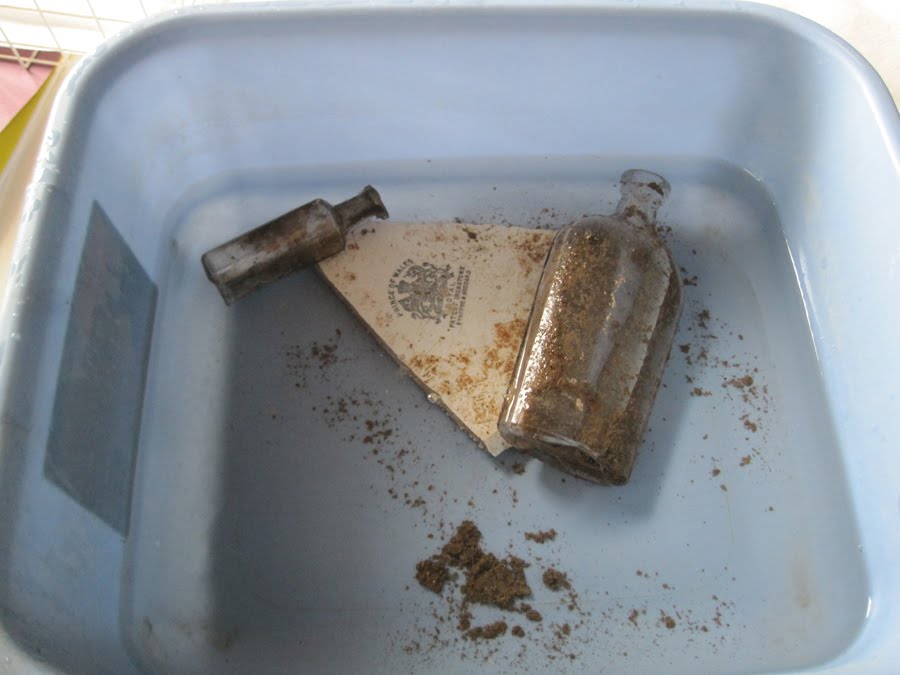
Water and a bucket. My tools for the afternoon also included a cup full of toothbrushes, pipe cleaners, cotton swabs, and tissues.

I invented a new tool to clean the bottle. I call it the field-expedient cottonswab and pipe cleaner apparatus - or FE-CAPCA - because I've also learned that the government really likes initialisms and acronyms

Generally, you can't use water on metal. Instead, dry brushes (seen on the right hand side of the picture) are used. The artifacts here are two nails and what I thought was a bell, but Burt said could also be some kind of censer (a kind of receptacle for burning incense).

This inscription, located on the back of a spoon handle, became visible once I cleaned the dirt off of it. It appears to say "RITAN" and has an image of what is either a crown of a chef's toque, and some small letters beneath. "KET", maybe? My guess is that it said PURITAN at some point in time.

"Guaranteed full 1/2 pint"! All clean. Thanks, FE-CAPCA.

Nothing like a basket of clean artifacts at the end of a day. These will eventually be cataloged and then make their way into storage at curation (which you can see in one of my earlier posts), but for now they have to dry.
Trying to strike that balance between conservation/protection and public use is probably the most complicated issue I've come across in my time at the park so far - and after spending the day with Winona Peterson (more on that later), one of our park's historians, I'm convinced there's no easy solution. The visitors come to see the resource - but visitor use can sometimes threaten the resource. Without visitors, there is no park - but without resources, there are no visitors.

I think the best thing that I can do as a LE ranger, then, is not just to demand rule compliance as if it were some grand arbitrary fiat - but rather take a page from the interp rangers and do some education. If visitors cutting social trails down the face of Little Round Top is causing the hill to erode (which they are - and it is), then it's probably beneficial to take them aside and tell them: "Hey, I understand you love this place and want to see more of it, but we only get one chance to preserve history. We get over a million and a half visitors in a year, and if they all walk down the side of the hill, then there's not going to be anything left of Little Round Top in the future." Or something like that.
Of course, sometimes people won't listen to you, or don't care, and in that case I don't think there's not much to do aside from punishing the violation by whatever means are appropriate for the situation. But discounting that, I think most people are reasonable and appreciate being treated as such. I'll definitely have to do more observations of conflict resolution styles, though. I've still got a lot (and by a lot, I mean everything) to learn!
Sunday, June 20, 2010
US Park Police Eagle 2 - GETT

Me and Eagle 2.
Yesterday, we had the pleasure of working with the Park Police again, and this time I got pose for a picture with Eagle 2. Sweet! This photo was taken on the ground just outside the old Cyclorama building.
Tuesday, I'll be starting my two weeks with Resource Management/Planning. As an Anthropology major, I'm excited, because that means I might get to spend a few days with our park's archaeologist.
Saturday, June 12, 2010
Cattle Corraling - GETT

A small portion of the calves from the herd. The older ones are far less curious.
Well, in all honesty - it was just one calf, but still . . .
Gettysburg has a lot of fields and fences, some of which we lease to farmers who in turn work the land. I don't really know anything about the agricultural leases or how they work, so I can't say too much about them unfortunately - but what I can say is that we maintain the historic fences around these farms, and that portions of them (usually just the top beam) do on occasion fall down or get knocked over by the animals grazing inside. This in turn tends to lead to escaped farm animals.
This morning, we were called over to one such leased farm to corral a calf. This particular calf - #997 - had already escaped on numerous other occasions in the past. According to our Park Watch volunteers, he even jumped clear over a fence on at least one occasion.

Ranger Ryan Levins secures the gate afterward as the calves watch.
Once we get the cattle back to where they belong, search for and repair any fence damage, we usually notify the farmer. Until that point, however, getting the animal back where it belongs is our responsibility since it's on park property.
It was an interesting way to start the morning. I got to run along side a calf while holding a video camera, with my arms spread out so that it wouldn't try to turn backwards or towards me.
"He doesn't know what's about to happen." Ranger Levins and I coerce the calf back into the pasture.
Friday, June 11, 2010
Volunteers - GETT

The 18 Venturers of Crew 615 clear brush along the area of the High Water Mark known as "The Angle," one of our most-visited and visible areas of the park.
I've mentioned before about how incredible the attitude of the people within and around Gettysburg is, but I don't think it can be stressed enough just how dedicated the people who work here and the visitors are to this place.
I was fortunate enough to work with Angel De Jesus today, inside the administration of our maintenance division. He administers the Adopt-a-Position program in the park, among other things, and is an incredibly busy man. Despite this, he took some time to explain to me some of the ways the park takes advantage of the massive volunteer support it receives. For example, in 2008, Adopt-a-Position volunteers logged nearly 7,000 hours of work maintaining the grounds of the battlefields. Our Park Watch program (which works alongside the Law Enforcement Division), as well, recently celebrated completing its 100,000th patrol hour.

Angel told me that he likes to meet the volunteers personally, taking pictures as they work and e-mailing them to the volunteers afterward. This helps reinforce our park's relationship with the volunteer groups, and lets them know how important they are to us. Here, he photographs some of the crew working.
Early in the afternoon, I was able to follow Angel as he met with Venturing Crew 615, which had traveled all the way from Augusta Georgia in order to complete a service project here at Gettysburg. In just one day, the 18 of them completed 54 hours worth of very hard labor, manually hacking overgrown weeds and tangled honeysuckle bushes down with clippers and swing blades near historic stone and wooden fences along areas too delicate for our mowers to reach. This difficult work helps us maintain the historic appearance of the battlefield in order to honor the fallen and the men who fought here.

Carlos Garcia and Angel De Jesus (far background) supervise the crew as they work The Angle.
I keep hearing that once you work at Gettysburg, you never leave - and I'm starting to see why. The people love this park and their enthusiasm is infectious. During the busy season, we have multiple groups of volunteers who come from all around the country (some of our Adopt-a-Position VIPs travel all the way from California) every day for the specific purpose of helping maintain the battlefield. Personally, I love these people. I think they're fantastic and the work they do is phenomenal.
Being able to work and have contact with these volunteers is incredible. Their enthusiasm and love for the park is just so apparent when you talk with them, and their eagerness to put in hours of very hard physical labor on their own time really rubs off on you. If you're ever having a bad day or feeling off for whatever reason, talking to a volunteer for just a couple minutes really sets things right again and puts everything in perspective. We're very fortunate to have such proactive supporters, and working with and for them to maintain and protect these cherished places is nothing short of a great honor.
Thursday, June 10, 2010
Reconstructing the Barn at East Cavalry Field - GETT

The barn: my workplace for the past few days.
This past week I've been working in the maintenance division, helping to reconstruct a historical barn out near East Cavalry Field.
One of the most interesting things about the building of this barn is that the NPS and the carpenters I've been assisting have a real dedication to maintaining the historical appearance of the barn, from the meticulously-matched custom paint on the outside all the way down to the structural beams on the inside.
Any time you take a tool to a medium, it leaves evidence of its use. Normally, this isn't much of a problem, but since we are interested in preserving a historical structure rather than simply building a modern facsimile, the traces of the modern tools we use have to be removed so that the restoration is as seamless as possible.
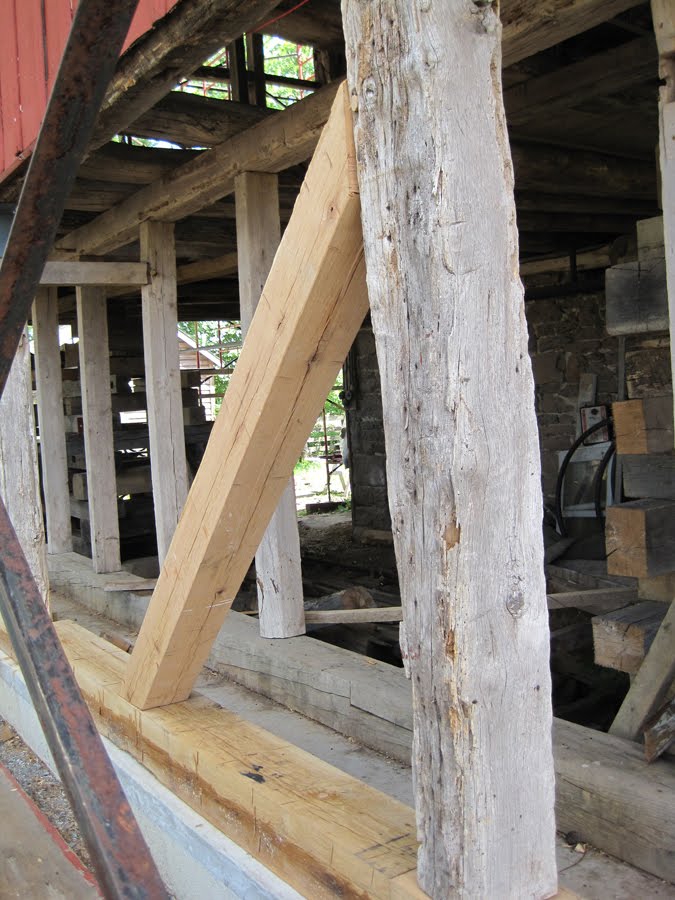
Old and new beams.
To this end, the carpenters here try to re-use as much of the original wood as possible, stripping, moisturizing (with a linseed oil and turpentine mixture) and re-painting it when it is structurally safe to do so, and replacing it when it is not. Some of the larger structural beams were in bad shape and fell into this latter category, but before they could be placed inside, they needed a bit of touching up.

Modern-cut plank. You can see the circular saw marks along its surface.
Wood cut with a modern circular saw is usually covered in visible arcing furrows caused by the teeth of the blade passing through as it is cut. These have to be removed using a planer.

This planer saw a lot of work. As you pass it over the wood, it levels the surface, eventually removing the furrows completely, until the face of wood is smooth.

A comparison of the original beam and its replacement.
Planing is good, but not good enough. If you look closely at the aged beam in this picture, you can see a number of lateral (perpendicular to the beam itself) gashes going up its side. These were caused by the original carpenters using axes (not planers) to level the wood.
The carpenters recreate this notched appearance by taking a small axe and striking the wood at an angle. I got to strike at a beam myself on Tuesday, which I found to be very therapeutic. As a special bonus, I'll know that there's a beam of wood inside the barn that will have my unique series crosswise gashes on it for, hopefully, another two hundred years or so.
Maybe I'll take my children to see it someday. I bet they'll be super impressed. Or not.

Gary recreates a historic wood joint used to hold beams together, using the original beam as a pattern. Many thanks to him, by the way. I didn't know anything about barns or carpentry until he took the time to teach me.
It hasn't been all axework this week, however. There's louvers to take care of. Louvers are the slatted "windows" you see on a barn. They allow airflow into the structure. This is important, because is a pile of hay or whatever plant-stuff you're piling needs to be able to "breathe" in order to dry properly. If it is not able to dry, much like a compost heap, it will steadily increase in temperature as the organic material is broken down. When it gets hot enough, this can potentially lead to spontaneous combustion.

Louvers! Already painted, so I have nothing to do here!
Since nobody wants the hay in their barn to suddenly explode into flames, and louvers also let in of light which can help you find your way around once inside - you'll probably spot louvers or some similar manner of ventilation systems on most storage barns.

Stripping the louver. I start the day out in coveralls, but by the time I get to painting, it's too hot to work like that and they end up half-unzipped. Oh well. The thought was there.
The louvers on the barn were in need of some love, so I got to strip the crusting old paint off of them, dust them off, prime them with oil-based paint - and then paint them over with a lovely green latex paint.

A stripped, upside-down louver.
Getting the paint off of the slats is actually kind of difficult. If you're trying to be conservative with the centuries-old wood, you're not going to be able to get all of the paint off. This is OK, though. We really only needed them smooth.

Painting the louvers with mint-green primer.
Like I mentioned before, it's really good to see the attention to detail put into the restoration of this barn. While I didn't do much other than paint louvers and siding (that's really all I'm capable of anyway, since I'm no carpenter), helping a with project as massive and visible as the reconstruction of a 1850's barn is a very gratifying experience - the measure of work you put into it is immediately visible to the same degree.
Testing the Radar - GETT

Allison, me and Ryan at the visitor center here at Gettysburg, ready to answer questions. Picture only tangentially related to the post below.
Last Saturday, I was able to ride along with my supervisor during patrol. Up until now, I'd only ridden in one of the big the SUVs - but since today was Park Day and we had a massive amount of volunteers show up to work on reconstructing the historical fence line along either side of one of the park roads, we wanted to make sure the work zone was as safe as possible. Therefore, it was time to take one of the interceptors and watch for speeders.

Tuning forks which vibrate at the speed marked.
The people driving through the park were pretty well-behaved, so we didn't make any stops (which is good.) - but I did get to see how the radar is tested before use. It involves little tuning forks, which when struck vibrate at a specific frequency (35 and 65 MPH for the two in the picture) - if the radar accurately detects the vibration of the forks, then it's good to go.
Ranger Ryan Levins, testing the radar unit.
Monday, June 7, 2010
Speeding Violations, Museum Services, and Thoughts - GETT

"An explanation must be furnished at once to the commission"
Some things never change. My supervisor, Ranger Levins, found a box of speeding violations down in the archives recently. We were able to take moment to look at a couple of them - primarily out of sheer curiosity. The explanations aren't much different than you'd get today on a traffic stop!

"I am not that kind of a person to violate rules"
As of now, they are just eight years short of being one hundred years old. I find something about the notion of a 100-year-old speeding ticket to be incredibly funny.

Spinning wheels!
As I mentioned earlier, we found these down in the archives. Museum Services/the archives (or "The Dungeon" as it is fondly called here) is where the park houses its massive collection of artifacts not currently on display.

Muskets!
In this climate-controlled, seismically-monitored room are endless rows of cabinets and drawers marked with labels that say things like "DRUMS", "COATS", and racks upon racks of artifacts such as these muskets.
 '
'Penn State intern Kristen Campbell, hard at work cataloging ramrods.
Presently, the interns and staff are cataloging these artifacts - which is an important task not only for the sake of taking stock, but making sure that the provenance of the particular relic being cataloged is maintained.
The provenance, or (to oversimplify) history of an item is important to establish and maintain because these seemingly random, cast-off remnants of the battle are all evidence of who was where, doing what at what time. Much like forensic evidence at a crime scene, even minor details such as their orientation in relation to other items found in the same "cache" are vital bits of information that can be understood by a trained individual - and then disseminated to the public and thus provide a greater understanding of the battle.
It then becomes our job as Protection Rangers to make sure that these resources are (for a lack of a better term) protected. Though I am told that Gettysburg, on the whole, is fairly well-cleaned of artifacts - it is still important to remain proactive against relic hunters and the like for the simple fact that it's impossible to know what might be out there on the field. Relic hunting is particularly devastating not only because it is is the theft of a park's resources, but it denies that resource and the knowledge it might be able to impart to the public. Typically, these stolen relics simply get shuffled about and sold as tokens without history or significance beyond "Civil War musket". As an anthropology major, I find this to be particularly disturbing, if not sad.

Ranger Ryan Levins, observing the battlefield from atop the 44th New York monument. (Believe it or not, this is actually a candid shot.)
On a random personal note, I am thrilled to think that some day I too will be able to gaze, hawklike, over the edge of some precipice in order to survey America's most beautiful, significant places.
Granted, I can do this now or any time I want, but who am I but a goofy intern with a camera? Once I finish the ProRanger program and get out of FLETC, it will be official. To me, that makes all the difference in the world. I think it feels really good to have life goals.
It's one thing to do well in college and know that you will graduate with good grades. That, in itself is fantastic, but does little to secure your future, especially in the present economy. So it's another thing entirely to know that you've got an incredible career waiting for you if you just work for it. I guess I'm having a grateful/"OMGLOLO I AM PSYCHED!1!!~" moment right now - but that's OK. Sometimes it's good to take a step back at the risk of possibly seeming corny.
Subscribe to:
Posts (Atom)