Showing posts with label Meaghan Bauder. Show all posts

Wednesday, July 10, 2013

A Hello From Everyone at SLETP


Hello everyone! It looks like you are all having a good time at your parks and learning a lot! All the ProRangers here at the Academy have been following your blogs and your internships seem like they are all really exciting! Our summer is flying by super fast. If your summer feel anything like ours then you cannot believe we have already hit the midway point!


 Things have been great here at the Academy at the good ol' Temple Ambler Campus where the grass is groomed, the flower beds are blooming, and the sun beats down on us during PT. The first couple weeks we were in the classroom learning all the critical law concepts necessary to be a law enforcement park ranger. Hard work and study groups have really paid off as we are proud to say that all twenty of the SLETP recruits have passed all the written exams so far! Everyone has connected and we work together as one cohesive group always willing to lend a helping hand whenever it is needed. 


Along the way, we have had some really incredible instructors who have not only taught us the material but have provided us with incredible advice that we will take with us throughout our careers. We have had some really physically demanding weeks as well. We are pushed to what we think is our limits just to show us that we are in fact mistaken; if we focus and dig deep there is always still more in us to push through and keep fighting. The warrior mindset is one of the key ideals ingrained it us to survive. 


We look forward to firearms training and emergency vehicle operations training these next few weeks. All the exciting stuff is still to come! Good luck to all the ProRangers spread around the beautiful National Parks and keep up the good work! 

Friday, July 6, 2012

CAHA Week 6- LE Education


I'm sure we've all heard someone say, ''knowledge is the key to success." We're told always continue to expand your mind. As young adults, we're urged to stay in school and further our education for as long as we possibly can, especially with the tough job market out there. Sometimes people only recognize knowledge as the education you get in a school setting; however, knowledge is comprised of so much more. For example, hands-on training is the necessary education you need to extend your book-smarts to more than just an A on an exam.


As a child I can here my Japanese grandmother's voice tell me "people can take a lot away from you, but no matter how hard someone tries they cannot ever take away the education you possess." She explains the more I continue to educate myself, the stronger an individual I become. Your mind is something no one can take away from you. Still to this day, my 83 year old grandmother continues to repeat this message to me.

My grandmother's 'words of wisdom' come to mind today, as I am 455 miles away from home at Cape Hatteras National Seashore learning about officer safety from my supervisor, Jim Churchman. I'm continuing to learn in the end, your biggest weapon and your strongest form of protection is your brain. It is your knowledge and quick thinking that will save your life. Knowing things like how to better position yourself and your vehicle, and how to keep yourself at an advantage and your suspect at a disadvantage, will add to your level of protection. These little bits and pieces of information may seem relatively insignificant in the realm of things, but that it far from true. Every action you take will either increase or decrease your level of protection and even your survival rate. My supervisor essentially reiterates my grandmother's words when he explains that a suspect may be able to take away my weapon, but they cannot take away my training, my education, and my knowledge; they cannot take from me the intangible knowledge I harbor within my mind.


This week I spent time learning about how to right reports and probable cause statements. I reviewed some previous reports and wrote my own practice draft of PC statement from an 'open container of alcohol in a motor vehicle' incident that occurred, and compared it with my supervisors'. We talked about ensuring the key facts and elements of the crime are obviously stated in the report. Articulation is extremely important when writing a solid report. With my supervisor overseeing my steps, I wrote out some of his written warnings for him and even a few tickets.

We spent a lot of time doing training. We focused on DUI enforcement and traffic stops. We talked about what to look for in a person's driving to spot an impaired driver. There are signs like drifting over the lines, failing to obey traffic control devices, swerving, sharp movements, irregular speeding and slowing down (no constant speed), and sudden stopping. For traffic stops we emphasized positioning of vehicle and yourself. The vehicle can act as a form of protection. Additionally, keeping yourself in a safe position of advantage adds to your protection and puts your suspect at a disadvantage. We even did mock trial stops to help reiterate these elements of a strong traffic stop.

Mock Traffic Stop

Explaining the Horizontal Gaze Nystagmus test
Keeping people from killing themselves and other people is a huge concern. Drivers under the influence are hazardous to themselves and to the public. Keeping drunk drivers off the road is a huge concern. My supervisor emphasized that we can use other violations to stop suspicious vehicles. For example, we can stop vehicles for things like no seat belts, no visible ORV permit, and speeding. This allows the officer the chance to talk to the driver, scope out the vehicle, smell for any signs of alcohol and drugs, and ultimately try to prevent bigger things like DUIs.

Vehicle stop- Arrest

When you do stop a vehicle and smell or see signs of alcohol, you can perform field sobriety tests like the Horizontal Gaze Nystagmus, the Walk-and-Turn, and the One-Leg Stand. During the HGN test, the officer looks for three indicators of impairment: lack of smooth pursuit, distinct and sustained nystagmus at maximum deviation, and onset prior to forty five degrees. These tests are cues of intoxication.

Right after practicing all of this, I got to see it in action when our officer pulled over an individual for not wearing his seat belt when leaving the beach. The individual was in an jeep wrangler. The traffic stop for a minor seat belt led to a field sobriety test, drug paraphernalia and marijuana possession, and ultimately an arrest.
I've always been an individual with a love for learning. I find learning intriguing. I love it down here at Cape Hatteras. It is not the 'ooo's' and the 'ahh's' or the living large and busting bad guys that is making my summer fun, but rather it is simply the learning aspect. Learning how to think like an officer and observe like one, learning how to spot a suspect from a distance, learning what to look for, learning how to protect myself, and simply just learning more than the ordinary.


Sunday, June 24, 2012

CAHA Wk 5- Tallest Lighthouse in America - A Guardian of the Sea


Cape Hatteras Lighthouse
We as human beings recognize there is much to be learned from our elders, both living and past. They've been around much longer than we have and have experienced so much more. We know their stories are meant to teach us and guide us. What we sometimes forget to realize is that if we take the time to silence the commotion from our lives and sit still long enough to see it, there is history in everything around us. There are stories to be told, journeys to be re-lived, and lessons to be learned. Spending the week with Interpretation gave me the opportunity to be reminded of this. I was able to engulf myself in the history surrounding Cape Hatteras National Seashore. As a result, I can see exactly why the National Park Service has recognized these shores as a place of value.

Cape Hatteras Museum Desk


Interp Ranger after a program

My stay with Interpretation has increased my knowledge of this park greatly. Just by shadowing the incredibly well versed and knowledgeable Interpretive Rangers here at Cape Hatteras, I was able to learn and retain so much incredible information about the park and the surrounding area. I was lucky enough to sit through the wide variety of educational programs offered. Some of the programs I attended were Barrier Island Nature, Pirate Program, Sea Turtle Program, and Sentinel of the Shore. I also took part in more hands-on interactive programs like Fishing, Snorkeling, and a Bird walk. In addition, I spent time in the museum, Visitors Center, and at the base, middle, and top of the lighthouse. I know the interpretive staff is the front line of the park because they spend the most time with visitors. All of the activities I took part in allowed me to interact with visitors and I tried to help make their visit to the park that much more memorable. 


Fishing- One of the many Interpretive Programs
I learned about the journey of the many species of birds that migrate here from places far and wide, the sea turtles who come back to their birthplace to lay their nests, the vegetation that has adapted to the sand blasting climate, the journeys of the shipwrecks that have washed ashore on these beaches, the ever changing shoreline, and the lighthouse that proudly stands here.


                   1803                1853                    1870                     1873              
Evolution of the Cape Hatteras Lighthouse    


The Cape Hatteras Lighthouse first began its journey in 1803 to protect sailors from the hazardous dangers of the Diamond Shoals that lie right off shore at the point of the island. Right off shores of Cape Hatteras is where the Labrador Current and the Gulf Stream collide. This current forces southbound ships into the Diamond Shoals-- a twelve-mile long sandbar. The reputation, "Graveyard of the Atlantic" quickly took hold and the need for a 'guardian of the sea' was eminent. Since 1803, the Cape Hatteras Lighthouse and the light itself has both undergone many alterations and each has a journey all its own. Withstanding hurricanes, earthquakes, erosion, and moved 2,900 feet in one piece in 1999, the lighthouse is still structurally sound and to this day stands proudly looking over the sea. The Cape Hatteras Lighthouse withstood both the wrath of mother nature and the irrepressible effects of father time, and is now a heartfelt symbol of the Cape Hatteras Seashore sharing with both its local inhabitants and its visitors the journey it went through and the journeys of others it has protected. 

Guardian of the Sea
The lighthouse beacon today

Tuesday, June 12, 2012

CAHA: LE Week 4- B&E, Missing Persons, Trauma Victim, & Drug Possession, etc.


It is now the end of Week 4 here at Cape Hatteras National Seashore, but it is certainly the start of a busy summer season. I worked the night shift four out of the five days this week. The night shift at a beach, especially on the weekend, provides a whirl wind of adventure and experience. Each night holds something new.
 
Dispatch Call: Beach Fire
 
Friday night Mark and I were patrolling Frisco Campground when we received a phone call from dispatch saying that there was black smoke coming from a beach campfire in Frisco and the caller said the individuals were burning boogie boards and other unauthorized materials. Beach fires are permitted until 10pm at night in certain areas as long as the individuals have a fire permit, are at least 50 ft from vegetation, are only burning wood (wood cannot contain nails), and the fire is not greater than 3 feet in diameter. We found the individuals who caused the disturbance. There was no sign of boogie boards being burned, however they claimed to be unaware of the need for a fire permit, their fire was too large in diameter and too close to vegetation. The volunteer fire department also arrived on scene after hearing the call from dispatch and extinguished the fire. Feeling gracious at the moment, my supervisor gave the individuals a written warning.
 
Dispatch Call: Breaking & Entering in Progress
 
(Which led to a K-9 Unit Arrival, Revoked Registration, Possession of Drugs and Drug Paraphernalia, beach fire violation, and dog of leash)
 

In the middle of this, we received another call from dispatch saying there was an attempted breaking and entering in progress in a vehicle in the Frisco Campground. We immediately responded and arrived on scene within minutes. The Dare County Sheriffs department's  K-9 unit was also in the area so they responded as well. They requested that we keep people off the site so the sent of the intruder would not be contaminated. The k-9 sniffed around, traced up the strongest scent, and took off running. He finally stopped and about 5 campsites over to an occupied lot P38 which was trashed with alcohol bottles and food. It was approximately 10pm at night and the occupants were no where to be found. While on scene, we noticed a suspicious car drive by the site and so Mark and I followed the vehicle. We ran the plate and discovered the plate was revoked. The vehicle pulled over and there were two young males and one young female in the vehicle. The individuals were indeed from the campsite that the K-9 led us to. The officer from Dare County used his K-9 unit to walked the perimeter of the car and signal for drugs. 
The K-9 is trained with a passive signal, so when he picks up on drugs he sits, which is exactly what he did. The officer said the K-9's signal was a strong one and indicated that drugs were in the car now or were really, really recently in there. After searching the vehicle my supervisor and one of the sheriffs found a mason jar with 7.5 grams of marijuana and drug paraphernalia (rolling papers and a metal pipe used for smoking marijuana). The owner of the car was not present, but was on the beach nearby with 5 more individuals. The two Dare County officers stayed with the first three suspects while my supervisor, another NPS LE officer, and myself walked onto the beach to get the driver. Arriving on the beach we came across even more violations. The individuals had a fire without a fire permit and on an area of the beach where fires are not permitted. Additionally, they had a dog on the beach without a leash. We rounded up the individuals and brought them back.
The owner confessed that the marijuana was his own and was arrested. Additionally, we seized his licence plate and he received three tickets: his revoked registration, illegal possession of a control substance, and possession of drug paraphernalia. After a long night and 3 1/2 hours of overtime, my supervisor called a 24 hour judge and we were able to release the individual right there on an unsecured bond. The following day we tested our evidence. The separation of purple over pink meant it was a positive match for THC. Mark and I recorded each piece of evidence in the evidence log and secured it into the evidence locker.
 
Dispatch Call- Missing Juvenile
 
Saturday presented a whole new set of adventures. There was a missing persons call from dispatch for a 17 year old boy who said he was going out for a walk on the beach in Avon near his rental home. He was last seen at 8:30pm and it was now dark and 10:30pm. Mark and I went covered a northern section of the beach near Avon Pier and another NPS LE searched a nearby section of the beach further South starting at ramp 38. We asked some individuals on the beach if they saw a boy matching his description and they said they were out there for hours and did not. We also notified them it was past 10pm so they needed to extinguish their fires. Moments later the other LE called us saying some people recently saw the boy on the beach further South, so we turned around and starting searching in that direction. A few minutes later we spotted the boy walking down the beach. Since it got dark faster than he thought, he said he had gotten lost and had been searching for his rental home ever since. We asked the boy if he needed any water or anything, helped him feel comfortable, and transported him back to his family, who were very relieved and grateful. 


After this, we responded to a noise complaint in Cape Point Campground and checked the nearby ramp, Ramp 44, to make sure there were no vehicles or fires on the beach. However, we came across a truck on the beach. There were two individuals fishing. My supervisor approached them and notified them that night driving on the beach was prohibited and all vehicles needed to be off the beach by 9pm. Mark then issued the driver a ticket for driving during prohibited hours since it was 2 1/2 hours past the time cars were no longer allowed on the beach. Night beach driving is a big deal here at Cape Hatteras because of the disturbance it causes the endangered sea turtles. The sea turtles are federally listed as endangered species to be protected. Sea turtles crawl up the beaches at night to dig a nest and lay their eggs. Artificial lights scare away the female sea turtle and she will turn away and crawl back out into the ocean if she is scared and no longer finds the area to be suitable for her nest. Protecting the sea turtle's natural nesting activities, as well as their nests, is crucial to the survival of the species. Approximately 1 in 1000 hatchlings will survive to adulthood. The percentage is even less for the eggs in general. It is the goal of the National Park Service to preserve and protect the natural habitat of the area.

Dispatch Call: Missing Person

Sunday Mark and I had another missing persons call. However, this one was completely different from the last. The person who called 911 found a little 3 year old girl left alone on the beach at approximately 9:30pm. The caller said he witnessed the father of the child tell the child to "follow the lights and you'll get home." Then the father walked away. The caller yelled for the father, caught up to him and spoke with him. He asked the man if he had a daughter and the man confusingly said yes then said no, but at one point said his daughter's name. In the end, the father walked over into the dunes of the beach and left his 3 year old daughter with these strangers. Moments later the mother and grandfather were on a search for both the husband and daughter and shockingly found her daughter alone on the beach at night with these strangers. The mother said both her daughter and husband were supposed to be in bed but she noticed they were missing then found the front door of her rental home left wide open. The daughter was safe, but the husband was still no where to be found.

Facts surrounding the husband up until this point:

- 30 years old
- Successful attorney with cases going successfully and smoothly for him
- Just purchased a home
- Loves his daughter more than anything & would never leave her alone
- No drug or alcohol use
- Lack of sleep (worked a few 20 hour shifts in a row before going to vacation. First day at the beach. Could not sleep the night before he drove. Drove 12 hours from NY)
- Has chronic Lyme's Disease (taking antibiotics)
- Was acting slightly paranoid at dinner but family thought it was due to lack of sleep.

Mark, the mother, and took our flashlights and searched in and out of those dunes in the beach where the husband was last spotted. Half of the Hatteras Island Rescue squad went to the family's rental home and the other half of Hatteras Island's Rescue Squad met up with us on the beach. However, about an hour into the search and as soon as they arrived, we received a phone call saying the husband just walked into the front door of their rental home. Relieved he was alive and safe, we transported the mother back to the home. When we arrived the ambulance was there checking him out. As questions were being asked, we found out the husband took his daughter from her bed and left because he thought the house was caving in on them (there were people exercising on the floor above them). However, the father could not answer the question as to why he left his daughter on the beach and walked away. He was so confused and slowly began to realize that there was something wrong with him. The family was so baffled by all of this and could not explain his irrational behavior either. They kept stressing that he was not on any type of drugs and all his behavior was completely out of character and abnormal. He was transported to the hospital for further analysis.

Dispatch Call: Trauma Victim

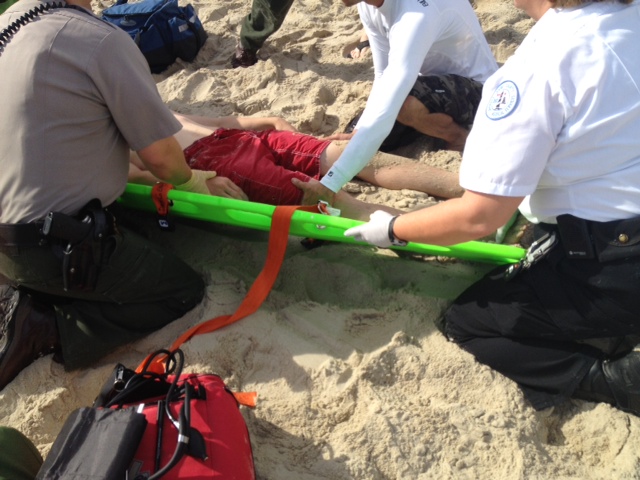
Monday, Mark and I were patrolling when a call came over for a trauma victim at Avon Pier. We ran code down the road and got on the beach at Avon Pier. As soon as we arrived we saw a 15 year old boy laying still on the beach. The boy was hit in his head by his boogie board when a wave crashed. The power of the wave caused the boogie board to knock him unconscious. He was pulled out of the water by his friends and guardians at the time. The Hatteras Island Rescue squad and their ambulance arrived on scene, checked the boy's vitals and other symptoms, then transported him to the hospital for further analysis because his head injury was severe.

Dispatch Call: Medical in the Cape Hatteras Lighthouse

Literally as soon as we finished with the trauma victim and before we even got back into our vehicles from the incident, we were called for a medical in the Cape Hatteras Lighthouse about 10 minutes down the road. the whole crew at the Avon Pier incident drove down to now answer this call. There was a young boy at the fourth landing inside the lighthouse who was dizzy, lightheaded, woozy, and displaying further signs of distress. An interp ranger helped him sit down and called in the medical. The boy was putt on the oxygen tank and assisted out of the lighthouse on a stokes basket. He was such a strong little trooper. He was transported with his parents' to the hospital for further analysis.

Tuesday, June 5, 2012

Week 3- Cape Hatteras

My week started off with something new. I spent half the day in the Off-Road Vehicle office giving a helping hand. I learned all about the new permits and luckily did not have any upset customers that morning. The big holiday weekend that passed resulted in a mass amount of newly purchased permits. The high demand for permits also meant a backlog of paper copies that needed to be entered into the computer. I logged a ton of the new paper copies into the computer, but barely made a dent in the pile. The second half of the day was spent at Frisco Campground. With Memorial Day finished, the full campground was quickly vacated lot by lot as individuals went back to their daily lives. I went around the campground and checked on all the newly vacated lots to make sure no trash or random items were left behind for the next campers.

Least Tern Egg
Piping Plover Nest
After this, I spent the remainder of the week with the Resource division here at Cape Hatteras. I had such a wonderful experience! It is the goal of the National Park Service to protect both federally acclaimed and state mandated endangered species. The most common dealt with here at CAHA are Sea Turtles, American Oyster Catchers, and Piping Plovers. Sea Turtles are a federally endangered species, Piping Plover birds are federally threatened on the Atlantic Coast, and the American Oyster Catcher bird is a state species of concern. The new Off-Road Vehicle management plan states there should be a certain size buffer zone for nests found. The size of the buffer zones vary based on the species of the animal. Additionally, if more nest activity is discovered near the edge of the buffer zone, then the zone is expanded. All the visual and GPS coordinates are logged into an underway GIS database where it will store the information and can be used to find trends of areas that the species repeatedly show activity at each year. These GPS Waypoints are also going to be used for the adapted ORV plan to determine future buffer zones. For example, the Piping Plover chicks use and need the entire 1000 meter recommended buffer zone. Therefore, once Piping Plover chicks hatch then 1000 meters of the beach his automatically shut down to vehicles and pedestrians. The GPS Waypoints keep a note on how far the chicks travel and how much space they are utilizing so the park can determine if it is going to be necessary to close off the entire 1000 meters of beach.

Salt Pond Drainage
I spent a lot of time up at Cape Point. It is currently closed off completely to the public. There were so many different type of birds there and it was such a nice, intriguing, and relaxing sight to observe the birds in their natural habitat. Each day we checked on both the breading birds and the non-breading birds using their last known Waypoint location then documented their activity. I had the chance to check up on American Oyster chicks approximately 25 days old. We also checked up on maturing Piping Plover chicks and waited to see if there was any sign of attempted flight yet. Once the chicks can fly, then the closure can be prepared to be removed.

American Oyster Catchers & Chicks
In order to identify the American Oyster Catchers, the chicks are banded by color, letters, and numbers. Each color represents the state the bird was banded in. Green is the state color for North Carolina. The letters and numbers are used as identification of the bird. The most I saw all together were 8 American Oyster Catchers 2 banded and 6 unbanded. Overall, during my week with Resource, I checked on nests, observed birds loafing, forging, scraping, copulating, incubating, and acting territorial. I spent the week learning each birds' individuality, listening to their bird calls and simply observing them in their natural habitats.


Sea Turtle Nest Enclosure
I  got up at the break of dawn and worked the early morning turtle patrol shift. I did three turtle patrol shifts. One on the north end of the beach and two on the south end. We looked for any signs of turtle activity that could have occurred overnight. Sea turtles come to the shore during nesting season to lay their eggs on the beach. The turtle's trail leads us straight to their nest where we can log its location and protect the area from visitors. There are approximately 25 sea turtles nests discovered so far. In each nest there are approximately 80-120 eggs. Unfortunately, I was not lucky enough to discover a new nest during my turtle patrols yet. It just so happened that the mornings I was on the north end, a nest was found on the south end that day, and vice versa. I have been invited to ride along anytime for the rest of the summer. I certainly would like to, even if on my free time, and I definitely want to do volunteer night watch when the sea turtles are close to hatching.

Tuesday, May 29, 2012

Memorial Day Weekend at CAHA- Week 2

Honoring those past and present who serve our country
Happy Memorial Day
First, I would like to let everyone know this was quite an eventful week, especially an eventful Memorial Day weekend. Cape Hatteras National Seashore is a park that attracts millions of people each year for a variety of activities. Memorial Day weekend is the unofficial start of summertime. For everyone, and especially all the ProRangers reading this blog, this entry will be a long one, but I think it is an entry that shows you the diverse roles of NPS Law Enforcement, and I think writing about the variety is important in itself.

One of my supervisors, Mark Kreb started out my second work week by teaching me how to prep a vehicle to make sure all the necessary parts like lights and sirens are functional. He then taught me how to test the speed radar to make sure it is accurate. He told me at the beginning of each day all of these elements should be done and the day after an arrest you should check the back seat to make sure there is not any left over items that could be used as evidence. The following day right off the bat the first thing my supervisor did was test me on these procedures, and of course being a ProRanger I passed with flying colors.
Later in the day, I learned how to dissemble and clean both a pistol and a shotgun. It is important to ensure the weapons will work when the time comes when you'll need to use them. Additionally, by cleaning the weapons we are preventing rusting of the weapon, which is especially important with the moisture filled air and climate here at Cape Hatteras.


Here at Cape Hatteras we take a lot of proactive measures. We try to keep the park as clean as possible. When surfers come, the park will get surf stickers placed on stop signs and other signs around the park. If we see this, we immediately remove them so people continue to respect the area and it does not attract other people to do the same thing in the future. Additionally, Mark Krebs and I fixed any signs we found that needed adjusting. With the changing tide, the 4x4 signs placed in the sand sometimes sink too low into the sand. With the big weekend approaching and the wave of people arriving, we wanted to make sure the signs were clearly visible to all the visitors. We raised the signs to about eye level and removed worn down signs with new ones, to make them more noticeable, readable, and help increase the compliance rate.
                          

There was a tropical storm headed in our direction and so it created heavy waves and an extremely strong rip current. When Mark and I saw people far out in the water we stopped and took the time to tell them to be safe. We educated them on the dangers of the rip currents and what to do if they get stuck in a rip current. We wanted to proactively prevent as much injuries and deaths as possible. Even still, with approximately 30 miles of beach in our area, there were many water rescues called in to dispatch. In most cases the individuals swim out of the rip current themselves before situations get really serious. However, there were two instances that stood out. The first was an instance where two people had overturned their kayaks and were sucked into the rip current. Onlookers called 911 and dispatch notified everyone. As we were on the way, the situation intensified when the onlookers lost sight of one of the victims. A few seconds later the situation intensified even more when three different people went in the ocean to attempt to rescue the struggling individuals, but they themselves were also pulled into the rip current, making a total of 5 people in the water without any type of flotation or life saving devices. Since the number of distressed victims increased, more units were in route. Arriving on scene were the Hatteras Island Volunteer Rescue Squad, Dare County EMS, and Station 46 Avon Volunteer Fire Department. To ensure no confusion between the organizations an immediate chain of command was established under the chief of the rescue squad. I am relieved to say all individuals made it out of the water safely. The second incident involved a boy about 19 or 20 years old. He was surfing for the first time and immediately got pulled into the rip current. He struggled to get out and his friends yelled for him to try to swim back to shore. He struggled so much, ditched his surf board, kept trying to make it to shore, but continued to swallow so much sea water and began to tire. He was near drowning when Brooke, an off-duty lifeguard, arrived on the beach to because she left her blanket there. Without any flotation devices in her possession and without hesitation she yelled "Call 911" and immediately dove in the water after the boy. Hearing this on dispatch we were no more than 5 minutes away and arrived on scene in no time. The off-duty lifeguard used the surfboard as a flotation device and successfully got the boy out of the rip current and safely to shore. He was too weak to walk so my supervisor and I transported him off the beach to the EMS ambulance that arrived seconds later. The boy was so grateful to be alive and kept saying he swore he was going to die out there. He could not get over the fact that he was alive. It is truly remarkable that the off-duty lifeguard just happened to be there. She saved his life and he was truly grateful.

The following day, the lifeguards red flagged the section of the ocean they protected, meaning they recommended not going into the water. Mother nature was being vicious so to prevent as many water rescues or injuries caused by hazardous waves, they red flagged it. Again, the people at CAHA were trying to be proactive instead of reactive. so we took the time to warn people we saw in the water about the dangers of the waves and the rip current.


One early afternoon Mark and I stopped by the Interpretation Training session. He spoke about the current issues, informed the interpretive staff to keep a lookout for any suspicious activity, and told the staff not to hesitate to call for assistance. He told them they are the "eyes and ears" of the park. Due to the current tension between the park service and the locals surrounding the new regulations, new Off Road Vehicle (ORV) Permits, and the animal closures, Mark told everyone in the training to report any type of harassment they might receive from the locals or the local businesses.
With Memorial Day weekend being the unofficial jump start of summer, the park was prepared for the mass influx of visitors. This weekend was the big test as to see whether people will comply with the new ORV regulations put in place in February. As we patrolled the beach throughout the entire weekend, there was probably a 95% compliance rate for either weekly or yearly permits. I was quite surprised there was such a high compliance rate, especially with the high volume of cars on the beach. The Camp Point campground was closed during the holiday weekend because of the temporary safety stand down on mowing, which caused the campground site to not ill prepared for visitors. The snakes inhabiting the high grass posed a threat to visitors. Additionally, all the rain that has been hitting us lately has caused a lot of the campground to be swampy. The campground was just unfit for visitors. This resulted in 200 less spaces for campers. The Frisco Campground was completely full for the entire holiday and the extra campers were suggested to go to the nearby private campgrounds.

Overall the holiday weekend went smoothly. There were a total of 5 arrests, mostly surrounding alcohol use or possession of illegal substances. The day after the arrest at the start of my shift the first thing Mark asked me was, "What's the first thing you do after you arrest someone?" and my answer was "check the back seat for anything that might have dropped back there" and low and behold that is exactly what he had me do. From these arrests, I learned how to log all the evidence.


There were a few incidents in which passengers had open containers of alcohol in the car. Jim, one of my supervisors, has a knack for these things and reads people really well. He looks at their reaction to law enforcement and pays specific attention to detail. On one incident he was nearby Mark and I at a vehicle stop and watched the reactions of individuals driving by to our presence. He witnessed a passenger in a car notice us and put something down near his feet. Jim then also witnessed them fail to use a turn signal so he was able to pull them over for that, where just as he imagined, he came upon an open container in the car. Jim urges me to remember I have five senses and I can use every single one of them to scope out a situation. It is not so much about the little things, but more about safety of the drivers, passengers, and the other people on the road. We want to prevent drinking and driving, we want to prevent injuries, and we want to prevent death. The LE rangers here at Cape Hatteras are very proactive and very serious about the safety of others as well as the safety of themselves. This weekend I witnessed a lot of field sobriety tests. Moreover, I learned a whole lot.

Saturday, May 19, 2012

A Warm Welcome from Cape Hatteras National Seashore


Upon entering the park and seeing the grand Cape Hatteras National Seashore sign for CAHA headquarters I thought to myself, "After 8 hours of driving, wow this is it I am finally here!" Little did I know I still had another hour of driving. About 50 miles and several towns later I arrived at the ranger station I'd be working at. I had a warm welcome from my supervisor, Jim Churchman.

My first day of work was filled with a lot of orientation. My supervisor and I drove up to headquarters where we took care of some paper work and I met the Chief Law Enforcement Ranger. The chief was nice enough to walk me around headquarters and introduce me, and the ProRanger program, to the staff and the chiefs of each division. Everyone that I met seemed to be on board with the program and excited for me to be here. They were all extremely eager and ready to help. I can honestly say that every single person I met told me to feel free to come to them if I needed anything at all and offered to help in anyway possible. I am very grateful to have such a warm welcome. The park is absolutely beautiful and even the weather gave me a warm welcoming with a double rainbow over the campground.

Cape Hatteras Lighthouse


The first thing my supervisor had me do was to write out a list of things I'd like to see, do, learn, and/or experience during my internship at Cape Hatteras this summer. I think this was a great idea because it will allow us both to have a better understanding of where we stand this summer and will allow my supervisor to try to give me the best experience possible.
I am really eager for this summer. I think Cape Hatteras is a perfect park for a second season intern because of the wide variety of law enforcement that is done here. I am very excited to work both with my supervisor and Sarah Rutter's supervisor, Mark Krebs. I know there is a lot I can learn from them both.

I have been working the night shift. It has been raining a lot so the beach has been fairly empty and quiet. Therefore, on the second day of work we did some patrolling on the beach and my supervisor introduced me to the highway traffic stops. He went over what to look for in both the vehicles passing by as well as the people within those vehicles. We looked for probable cause to pull a vehicle over, but we also paid attention to the drivers' reactions to our presence. Jim went over the use of discretion and officer safety techniques when doing traffic stops. Stopping individuals who exceed the speed limit is both a direct and indirect warning. It is a direct warning (or citation) to the specific individual who disobeyed the traffic laws, and functions also as an indirect warning to all the vehicles that drive by and witness the stop. It is a friendly reminder there are repercussions for any illegal actions that can pose a threat to both themselves and to others.

During one of the traffic stops, we noticed that our left rear tire went flat. After the traffic stop was complete, the sheriff of the Dare County Sheriff's Deptartment came to help up. The Law Enforcement at CAHA has a close relationship to the Dare County Sherrif's Department and they both help support each other. The Sheriff blocked off the section of the road with his vehicle to make sure that it was safe for us to fix our flat tire. After that was complete we both went our separate ways to continue patrolling the area. However, only moments later we were called as back up to a traffic stop for the sheriff. He pulled over a vehicle for speeding. The driver was doing 80 mph in a 55 mph zone. Upon approaching the vehicle, the sheriff noticed the smell of alcohol. All three individuals were underage and had consumed alcohol. The driver's blood alcohol content was over the legal limit for a minor. With permission to search the vehicle, the sheriff did so and discovered marijuana and marijuana paraphernalia. After talking to the individuals for a while, he wrote them all up and gave the driver multiple citations, including one for the alcohol and one for the drugs. Finally, they arranged to have someone sober come pick them up. We were called as backup to this traffic stop to ensure officer safety, especially in incidents where the officer's back might be to the individuals or any incident where the officer is exposed, like during the search of the vehicle. This was the end of the night for Jim and I.

I can already see that Cape Hatteras offers such a wide variety of Law Enforcement encounters. I am really eager for what the rest of summer has to hold!