Showing posts with label Yosemite NP. Show all posts

Monday, April 27, 2020

Half Dome


Half Dome


Hello ProRangers and park people! For my wilderness patrol this weekend, I spent some time up at Half Dome. My 15 mile journey began on the Mist Trail (featured in last week's blog) and brought me up to LYV before I began the last and most challenging leg of the journey climbing Half Dome. When the park is open, summiting Half Dome is one of the most popular activities undertaken by visitors. Each day, 300 permits are issued for visitors to make their way to the top of this iconic landmark. However, with the park currently closed to visitors, I didn't encounter anyone along the way. I did however remove trash along the trail and surveyed snow packs to determine when the trail can reopen. After making my way up the Sub Dome, I reached the base of Half Dome's cables. Normally, Half Dome is accessible through the use of wire cables and wooden slats that help visitors climb the towering peak. During the winter, the wires and wooden slats are removed leaving the cables lying on the surface. While it is still possible to climb Half Dome without the assistance of the wire railing and wooden slats, the approach is much different. To climb Half dome, I used a Prussik hitch and personal anchoring system that would arrest a potential fall. After securing my harness, helmet, climbing gloves and climbing shoes, I attached myself to the cables and started the long journey upward. 

The start of the cables. A sign reminds climbers of the danger climbing during inclement weather can cause. 

Climbing the cables using a prussik hitch and personal anchor system.

Taking a break to admire the incredible view!
After completing the first pitch of the cables, there is a split in the cables that requires climbers to switch their gear. This was the most challenging part, as I had to remove part of my gear from one cable and place it on another. It is important to remember to always have multiple mechanisms in place to protect yourself while climbing. In this case, I removed one of my anchors and placed it on the new cable while staying securely attached to another. When it comes to climbing, redundancy is crucial!


After over 40 minutes of climbing, I reached the top! After a quick lunch (and many pictures) it was time to make my way back down. Luckily, going down was much easier as gravity did most of the work. Using the prussik hitch, I was able to gradually lower myself down to the base of Half Dome. 

View of Yosemite Valley atop Half Dome

The "Diving Board"
After climbing Half Dome the only thing left to do was complete another 7.5 miles of hiking to return to Yosemite Valley. While most visitors do not complete Half Dome in one day, it is possible. However, it is important to know your limits and reserve energy for the long hike back. Completing this trip provided me with insight as to what most visitors will encounter. Now, I can more accurately define the hazards and precautions necessary for a fun yet safe experience. 

Elevation gain during the hike. From Yosemite Valley to Half Dome the elevation gain is nearly 5300 ft!
Map depicting the route I took to reach Half Dome. 
This week, I will be working with the search and rescue office in addition to some more wilderness patrols. I look forward to sharing my experiences with you again next week!

Until next time,

ProRanger Caruso 

Monday, April 20, 2020

Little Yosemite Valley (LYV)


Little Yosemite Valley

Nevada Falls 
Hello ProRangers and park people! This week I patrolled the Mist Trail and hiked to Little Yosemite Valley (LYV). During my patrol, I looked for fallen trees and other trail obstructions to determine when the trail can be reopened for the season. I also contacted seven individuals during my patrol who violated the existing trail closure and provided information and warnings to comply with trail closures. To wrap up the week, I participated in a few COVID-19 scenarios conducted by the Valley EMS crew. These scenarios help test out current protocols and provide insight into ways we can improve our response for future calls. 

Although I have previously hiked the Mist Trail, this weekends patrol was even more spectacular as both Vernal and Nevada falls were very active after recent snowfall and storms. The additional water falling from the falls created a fine mist that coated rocks and made for a stunning rainbow. During my patrol, I familiarized myself with the trail and identified common areas for search and rescues. 
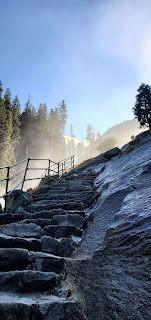

The Trail up the Nevada Falls is often slick with mist and can create hazardous conditions. This section is referred to as the "wet steps".


Following the "wet steps", the "dry steps" provide another landmark for future SAR's
After hiking up the "wet" and "dry" steps, visitors arrive at Emerald pool atop Vernal Falls. Although this pool looks calm and inviting for swimming, the current is very strong and often catches people off guard leading to significant injury and even death. For this reason, swimming in Emerald Pool is prohibited. 

Emerald Pool atop Vernal Falls
After reaching Vernal Falls I hiked to Nevada Falls, a 594-foot high waterfall fed by the Merced River. During this time, I encountered a number of hikers who violated the Mist Trail closure in order to reach Nevada Falls. I educated each hiker on the public use limit and informed them they would need to hike back to the valley using a safer route. While everyone wants the opportunity to hike, doing so on a closed trail poses a number of risks. On the Mist Trail, rockfalls, ice and snow can often lead to disaster. For these reasons, the trail is often closed until all snow and ice have melted. Furthermore, due to the risk of COVID-19 exposure, there is limited EMS/SAR operations available in the park. Combined, these factors have led to a number of trail closures in Yosemite Valley. Ensuring compliance with trail closures is an important task and something I look forward to doing more as the season progresses. 

After reaching the top of Nevada falls, I took the John Muir Trail (JMT) junction to Little Yosemite Valley (LYV). This trail is popular during the summer when hundreds of hikers make their way to the Half Dome cables. During the summer season, I will be stationed at the LYV ranger station checking camping/hiking permits for the 300 people allowed to summit Half Dome per day. Given the amount of time I will be spending at LYV during the summer, this weeks patrol provided a great opportunity to get acquainted with where I will be staying. While hiking the additional mile from the JMT junction to LYV, I took note of multiple fallen trees and debris that will be cleared by the trail crew. 

Fallen trees across the trail
Entering Little Yosemite Valley
After making my way up to LYV, I checked the Ranger's station for any environmental or animal damage. Luckily, the Ranger's station was free from damage. In the coming weeks, I will return to LYV to set up solar panels, a water tank, and tents for those who will be checking permits and maintaining the trail system. 

A portion of the LYV Ranger's Station

Bathroom and campsite at LYV

In addition to patrolling the Mist Trail, I also participated in a number of EMS COVID-19 scenarios this week. These scenarios test our preparedness for a possible COVID-19 case in the park and bring to light areas for improvement. During these scenarios, I assumed the role of a patient as well as a dispatcher. After countless scenarios, I am confident that we are well prepared to handle a possible or confirmed case of COVID-19 in the park. Nevertheless, practice makes perfect!

COVID-19 Scenario 

I look forward to sharing my experiences with you again next week.

Until next time,

ProRanger Caruso 


Sunday, April 12, 2020

Wilderness Patrols


Wilderness Patrols 


View of Yosemite Valley and Half Dome from Union Point
Hello ProRangers and park people! This past week I spent time working in the Yosemite Medical clinic and on the Valley Ambulance. However, this weekend I also had the opportunity to conduct my first wilderness patrol! Although the park is currently closed to visitors, wilderness patrols ensure trail systems are well maintained for future use. This week, I patrolled a section of the Four Mile trail, which provides spectacular views of Yosemite Valley, El Capitan, Half Dome and Yosemite Falls. During the patrol, I removed fallen debris from the trail, collected litter and surveyed snowfall to determine when the entirety of the trail will reopen. I look forward to conducting more wilderness patrols in the weeks to come and sharing my experiences with you!

View of Yosemite Falls from the Four Mile Trail
During the patrol I removed a lot of fallen debris from previous storms that obstructed the trail. Removing fallen branches and rocks from the trail limits the potential for future injuries and ensures visitors have a pleasant hiking experience. Removing debris from the trail also includes litter. Over the course of my patrol I removed plastic water bottles, wrappers and stickers from trail signs. While hiking a snowy section of trail, I realized that I wasn't the only one hiking! 

Debris blocking sections of the trail
A pile of litter and stickers found along the trail
Looks like I wasn't the only one on the trail!


Before and after picture with sticker removal

I look forward to another week here in Yosemite. Check back next week to see what I have been up to.

Until next time,

ProRanger Caruso


Tuesday, March 31, 2020

Yosemite Medical Clinic

Yosemite Medical Clinic

Yosemite Valley Ambulance 
Hello ProRangers and park people! This past week I spent time working in the Yosemite Medical Clinic triaging patients and assisting with medical procedures. In addition to my time in the clinic during the day, I have spent most of the last week on call covering the valley ambulance overnight. While the park is much quieter than usual due to the ongoing closure in response to concerns over the spread of COVID-19, a relatively large population of NPS and Aramark employees continue to reside in the park which necessitates staffing of the Medical Clinic and EMS services.

While working in the clinic, I primarily triage patients and assist with daily upkeep and operations. As a patient enters the clinic, they are brought back and assessed to determine their chief complaint or nature of illness. During this time, I assess vital signs and inform the receiving physician, nurse or doctor. For patients who are experiencing a cough, shortness of breath or fever, extra precautions are taken to ensure those healthcare providers working in the clinic, or on the ambulance, remain safe. Prior to entering the clinic, all patients are encouraged to wash their hands and wear a face mask if they are actively coughing. Patients who appear symptomatic are brought into a special triage room equipped with a negative pressure air purifying system. This system helps remove fine particles from the air which may harbor droplets infected with the COVID-19 virus. In addition to using a air purifying system, special personal protective equipment (PPE) is used while interacting with patients who may have the virus. For these patients, healthcare providers in the clinic wear a pair of gloves, a surgical gown, a n95 mask and a full face shield to protect the eyes and face. While this is not the most comfortable attire to wear, doing so ensures that suspected patients are not exposing anyone else to the virus. 

Example of the PPE utilized during an ambulance call
As of now, there are no confirmed cases of COVID-19 here in Yosemite or in any of the neighboring communities. While this is great news, it is important to stay vigilant and ensure all precautions are in place in the event someone tests positive. On the ambulances, extra PPE has been stocked to ensure providers are well equipped to respond to calls where a patient with COVID-19 may be encountered. As a precaution, all the valley ambulances were checked this past week to ensure compliance. To ensure all employees are staying up to date with the latest information and taking all necessary precautions, a incident management team (IMT) was established to handle all day to day communication and planning. The IMT is comprised of law enforcement officers, emergency services personnel, finance personnel, telecommunications personnel and a myriad of representatives from other branches.  Through the efforts of the IMT, park employees and residents are regularly informed of park operations and ways to reduce the risk of exposure. Witnessing the coordination among different park services and the implementation of an IMT is really interesting.

Inspecting one of the valley ambulances to ensure all necessary equipment is stocked


Although the park will be closed for the foreseeable future, I look forward to continuing my work in the Yosemite Medical Clinic and responding to calls on the valley ambulance. Check back next week to see what I have been up to!

Until next time,

ProRanger Caruso 

Monday, March 23, 2020

Covid-19 Closure

COVID-19 CLOSURE 

A layer of fresh snow covers the granite cliffs of Yosemite Valley
Hello Prorangers and park people! Since my last post, there have been some interesting developments here in Yosemite. In response to widespread concerns over Covid-19 and in accordance with the State of California, Yosemite National Park is closed indefinitely in order to protect park employees, residents and visitors. Although National Parks were established for the benefit and enjoyment off all, ensuring public safety is paramount. While there is still a lot of uncertainty both in the world and here in Yosemite, I am confident that the decision to temporarily close the park is in the best interest of all park employees and visitors. 

Part of the response to the growing Covid-19 pandemic focuses on social distancing and isolation to reduce exposure. While a majority of park employees are able to perform their duties remotely, there are a number of mission critical employees who, regardless of these precautions, must arrive to work each day and perform their duties. For the law enforcement officers, healthcare professionals, and countless other emergency services personnel in the park, coming to work each day in the face of a global pandemic represents what it means to be a public servant. This week, just as last week, I will continue working on the Valley ambulance and in the Yosemite Medical Clinic responding to emergency calls and caring for those who are sick or injured. While there are currently no reported cases of Covid-19 in Yosemite or the surrounding communities, precautions are in place to protect healthcare professionals and the greater Yosemite community from potential exposure. To aid in this endeavor, I designed some signs promoting social distancing that were placed around the park last week to remind visitors and park employees to practice proper hand washing and adhere to social distancing guidelines.

Social distancing signs designed for placement around the park
In other news, It snowed last week! After a long period of drought and above average temperatures, Yosemite received some much needed snowfall. I was beginning to think I wouldn't have the opportunity to witness the grandeur of Yosemite in winter, but last weeks snowfall was a pleasant surprise. Seeing the granite cliffs and pine trees covered in a layer of snow was a beautiful experience. With forecasts of snow continuing through the week, Yosemite is a winter wonderland!


Until next time,

ProRanger Caruso 

Sunday, March 15, 2020

Ready, Set, SAR!

Ready, Set, SAR!

Image result for nps search and rescue jpg
Hello ProRangers and park people! since my last post, there have been some exciting developments here in Yosemite. As the world grapples with the emerging COVID-19 virus, park staff have taken extra precautions to keep visitors and park employees safe. I spent a portion of the week on the valley ambulance and in the Yosemite Medical Clinic where patients were pre-screened to rule out possible infection. While there are currently no reported or suspected cases of Coronavirus in Yosemite, precautions are in place to ensure staff are equipped to handle the possibility. In addition to working in the clinic and on the ambulance, I participated in my first search and rescue (SAR) this week! Although the SAR was challenging and lengthy, I learned a lot of valuable information that will translate to other SAR's throughout my time in Yosemite.

Image result for covid 19

To prepare for the possibility of a suspected or confirmed case of Coronavirus here in Yosemite, Park officials and healthcare providers from the U.S. Department of Health created standard operating procedures for the medical clinic and the Park's ambulances. These procedures primarily focus on preventing the spread of Coronavirus through the use of personal protective equipment (PPE) and proper diagnoses. One way to ensure park staff and visitors are protected is to screen patients prior to contact with any healthcare providers. One way this is achieved is through coordination with the Park's emergency dispatch service. Dispatchers now screen all calls involving respiratory complaints and notify emergency services personnel prior to contact. Additionally, at the medical clinic, patients are screened prior to entering the building. I had the opportunity to assist screening patients this week to ensure patients experiencing a cough or fever wore PPE prior to entering the clinic. Once a patient experiencing symptoms was identified, I notified staff from the U.S. Department of Health who dawned PPE and examined the patient. While these precautions are more time consuming than normal, it is important in order to keep park staff and visitors safe. In the event a confirmed case of Coronavirus is found within Yosemite, plans are in place to transport the patient from the park to a hospital that can provide a higher level of patient care. While there is still a lot of uncertainty around whether or not the park will experience a positive case, I am confident that the procedures in place will ensure park staff and visitors are protected. 

In addition to screening patients for Coronavirus, I participated in my first SAR this week! On Wednesday, a report came in of a ill hiker on the Upper Yosemite Falls trail that was unable to hike down. Fortunately, a backcountry Ranger was on duty hiking the trail and was able to make contact with the patient within minutes. After examining the patient and determining that self rescue was not an option, the decision was made to coordinate a rescue. A mix of law enforcement rangers, paramedics and myself gathered at the SAR cache to gather gear and coordinate the rescue. During this time, the incident commander (IC) completed a risk calculation analysis (GAR) to identify any hazards that might be faced during the rescue. After determining the rescue was safe, medical supplies, a litter, and personal gear was gathered and loaded into the search and rescue van. From there, the SAR team headed for the Upper Yosemite Falls trailhead located at Camp 4. 

Image result for upper yosemite falls trailhead
Upper Yosemite Falls Trailhead
Once at the trailhead, members of the SAR team started to hike up to the patient. From previous reports, it was determined that the patient was approximately 90% up the trail towards the top of the falls on the upper switchbacks. I joined Park Ranger Nash as part of the "hasty" crew that moves quickly to the patient. Carrying the advanced life support (ALS) medical gear, I made my way up the trail towards the patient. After an hour and twenty minutes of hiking, I found the patient laying on the ground accompanied by backountry ranger Fisher. Once on scene, I assessed the patients vital signs and provided information to the IC. Roughly twenty minutes later, the remaining members of the SAR team arrived with the litter and other required gear. After the patient was assessed and given the required medication by one of the paramedics, the litter was assembled and the patient was packaged for transport. Now came the difficult task of carrying the patient down the trail. Accompanied by ProRanger Sender and the rest of the SAR team, we slowly made our way down the trail with the patient. Given the patients condition and steep terrain, the litter carry lasted over four hours and stretched into the evening. After hours of hiking, the SAR team successfully reached the trailhead where the ambulance was waiting. Once the patient was transferred from the litter to the ambulance, I assisted one of the paramedics in taking the patient to the hospital. Although this rescue was not as severe as some other SAR's, it was a great introduction to SAR in Yosemite and allowed for some great team building experience with a variety of park staff. While I hope there isn't a need for future SAR's, it is a reality of living in Yosemite and I look forward to participating in the future. 

As this week further proved, Rangers wear many hats! I look forward to another eventful week here in Yosemite. Check back next week to see what I have been up to.

Until next time,

ProRanger Caruso 

Sunday, March 8, 2020

On Belay

On Belay 

View of Yosemite Valley while climbing Royal Arches

Hello ProRangers and Park People! My fifth week in Yosemite was relatively uneventful working on the valley ambulance and in the search and rescue office. However, I want to share some of my recent workout activities with you. While I have been spending time in the gym and running throughout the valley,  I have also spent time climbing some of Yosemite's most iconic rock faces! This past week, I successfully climbed Royal Arches, considered by many to be one of Yosemite's all time classics. The 2,000 foot climb weaves its way up an impressive band of rock which includes over 15 pitches of varying degree. The climb includes sections of 5.7-5.9 grade pitches that offer stunning views of Yosemite Valley and Half Dome. While outdoor climbing is still new to me, I enjoyed the challenge of this climb and look forward to similar climbs in the future.

Although my previous climbs in Yosemite have introduced me to the world of outdoor climbing, climbing Royal Arches served as a test of my climbing abilities and endurance. Unlike the previous climbs I have undertaken in Yosemite, Royal Arches was much longer and required significantly more endurance in order to reach the top. After over two hours of climbing, I made it to the last pitch! During this climb, I learned some new climbing skills including different finger grip techniques and knots. I also practiced using different climbing devices such as cams. While I still have a lot to learn before I can start leading routes, each climb increases my abilities and serves as a great workout!

Royal Arches Climbing Route-2,000 ft and 15 pitches

Personal Anchor System 
View of Yosemite Valley halfway up Royal Arches
In addition to rock climbing, I have spent some time in the gym working out. Working on both strength and endurance will serve invaluable as I prepare to check permits on Half Dome this summer. Checking permits will require me to hike nearly 8 miles to little Yosemite Valley (6,000 ft elevation) prior to hiking another 4 miles to the top of Half Dome (8,000 ft elevation). While I am preparing for this summer, working out will also ensure I am at peak physical fitness for the start of academy in August. While I still have a lot of progress to make until I reach my goal, each day working out, climbing or running brings me a step closer to my fitness goals. Luckily, working out in Yosemite comes with incredible views that make it all worthwhile!


The view from my morning runs!
Looking forward to another fun and productive week here in Yosemite. Check back next week to see what I have been up to.

Until next time,

ProRanger Caruso


Tuesday, February 25, 2020

Med Ship Inbound

View of Half Dome from the Snow Creek Trail
Hello ProRangers and Park People! My fourth week in Yosemite was very eventful as preparations were made for the annual ALS refresher and I responded to emergency calls on the valley ambulance. I started the week assisting one of the park paramedics who is in charge of putting together the annual ALS refresher. The refresher is a week long series of lectures and scenarios for paramedics and parkmedics that reinforces existing knowledge while providing new information and techniques to ensure that medical providers in the park are up to date with current protocols and procedures. Although I am not currently an ALS provider, the refresher provided an opportunity to learn a lot of valuable information and network with experienced healthcare providers. Attending the refresher reinforced the importance of continuing education within the emergency medical field and furthered my interest in pursuing parkmedic certification. In addition to preparing for and attending portions of the ALS refresher this week, I responded to a EMS call that involved applying some skills and knowledge discussed during the refresher. The call exemplified the need for clear communication, incident command, and teamwork while working on a seriously injured patient. I look forward to attending the remaining portion of the ALS refresher this week and learning new information!

One of the most important presentations at the ALS refresher focused on first responder resiliency. As a first responder, it is common to care for those in need. However, caring for others can come at a cost. While responding to emergency calls, first repsonders can suffer physical and or emotional pain. Although the effects of responding to emergency calls and caring for others differs among emergency responders, it is important to care for yourself and colleagues. The presentation focused on dismantling stigmas that prevent first responders from acknowledging the effects of their work and encouraged self care. I am grateful to have been a part of this discussion where I learned how to manage stress and work through traumatic situations early in my career.

In addition to attending lectures presented by a variety of medical professionals, I also participated in a wide array of skills based scenarios. The first scenario focused on bleeding control through the use of a tourniquet and hemostatic gauze. I was able to refine my ability to utilize a tourniquet to control major bleeding while learning how to pack a wound (chicken breast) with hemostatic gauze. Even with these basic bleeding control skills, it is important to practice and stay sharp. Unbeknownst to me, I would apply a tourniquet to a patient only an hour after this scenario!

Self application of a tourniquet inferior to the knee

Hemostatic Gauze used in puncture wounds

Packing a simulated wound with hemostatic gauze

After the bleeding control scenario, I joined a group of ALS providers for a pediatric cardiac arrest scenario. The scenario was a great team building exercise in a high stress environment. Working as a team exemplified the need for clear communication during a medical call. Although I have practiced cardiac arrest skills for adult patients in the past, I learned a lot of new information specific to pediatric patients.

Pediatric Cardiac Arrest Scenario 


In addition to attending portions of the ALS refresher this week, I responded to my first trauma call in the park that involved applying some skills and knowledge discussed during the refresher. After falling from 15 feet, a climber sustained a significant injury that resulted in the use of a tourniquet and lower extremity stabilization. The patient was ultimately flown out of the park on a med ship for more definitive care. While there is always room for improvement, I was amazed by the clear communication, teamwork and establishment of incident command early on during the call. Together, these skills ensured that the patient had the highest level of care possible.

PHI Med Ship landed in Ahwahnee meadow to transport the patient
Although this has been a busy work week, I have spent some of my time off reading, hiking and relaxing. This past weekend, I went on a rigorous hike up to Snow Creek that included some serious elevation gain and over 100 switchbacks! I also started reading a new book, "Off the Wall: Death in Yosemite" that documents all the known fatal mishaps in Yosemite. While gruesome at times, this book offers readers an inside look into search and rescue events in the park and cautions against making similar mistakes in the future. I look forward to the remainder of the ALS refresher and the opportunity to go on some ride alongs in the coming weeks.

Until next time,

ProRanger Caruso