Showing posts with label Stephanie Hudson. Show all posts

Monday, April 3, 2017

2017 Park Assignments!

The ProRanger Program is pleased to announce student assignments for Summer 2017!

Boston National Historical Park - Josh Leahy
Chesapeake and Ohio Canal National Historical Park - John Hardie
Christiansted National Historic Site - Brennan McAuley
Colonial National Historical Park - Sam Vecchione
Gettysburg National Military Park - Kyle Maurer
Hot Springs National Park - Nick Gosik
Mammoth Cave National Park - Angelo Algeri
San Juan National Historic Site - Brennan McAuley
Santa Monica Mountains National Recreation Area - Stephanie Hudson
Yosemite National Park - Justen Willliams

ProRangers Lauren Butler and Kayla McComsey will be postponing their first summer internship until Summer 2018.

Thursday, August 4, 2016

The Final Days!


As my first internship winds down, I'm starting to feel nostalgic but also excited about what is to come this next year. The internship ending is really a bittersweet feeling. I'm a bit luckier than all the other members of my cohort in that my park is very close to home and to Temple so I can come back a lot more frequently than others can.


My last week has been a whirlwind of activity. I had a visit to Hopewell Furnace, a sister site to Valley Forge, where my supervisor, my chief ranger, and myself all went to look over the alarm system. It was interesting and eye-opening to see just how much goes into protecting the resources of the park. It was also a great experience that shows inter-division cooperation. Not only was law enforcement involved to view the security risks, but maintenance was also in the loop because of the installation/removal/upkeep of the devices. Natural resources was also involved as the GIS specialist provided maps of the buildings that helped determine where security equipment should go. This was also inter-agency as it involved the local fire department, police department, and dispatch. It's a large project, but it's one that could really help protect the buildings and artifacts at Hopewell Furnace.


I was also able to go on a boat patrol for the first time this internship. This was a great experience as it showed another dimension to patrolling Valley Forge. Not only do the law enforcement rangers at Valley Forge have to do bike, foot, and vehicle patrols, but they also do boat patrols on the Schuylkill to ensure boaters are following all relevant regulations. We also do foot patrols of Catfish Island, in the middle of the Schuylkill, to ensure there is no illegal camping or anything of that nature going on.

Thursday, July 21, 2016

The Old And The New


Today at Valley Forge was a very interesting day! I had two things on my schedule for the day: 1) washing archaeological artifacts so that they can be sorted and cataloged, and 2) a photo safari of the park. Both of these were wonderfully unique experiences, and the contrast between delving into old artifacts and using modern technology to capture the beauty of the land was striking.

While I thought that washing artifacts for 4 hours would be boring (sorry John!), it was actually one of the best things I've done so far on my internship. Taking pieces of rock, pottery, slag, metal, bone, and glass, among other things, and gently scrubbing the dirt off to reveal what is underneath is a very rewarding experience. One piece of dirty bone seemed unremarkable, however, after rinsing it in the basin and removing the dirt with a toothbrush, scrapes could be seen in the bone that were not visible initially. Likewise, pieces of glass had obvious bubbles and imperfections that could indicate when, and possibly even where they were produced.

In the middle of washing artifacts, the archaeologist at Valley Forge, John, was asked to go investigate a site where shells and pottery had been found on the surface. We went off and mapped the site using GIS and picked up a sample of the artifacts we could readily see. When we got back to the Thomas House, John entered the points into his GIS map of Valley Forge archaeological sites and discovered the site we visited is actually a subsite within another site that used to be an old building. We had no idea when we were out there that we were in an already discovered site, so the artifacts we found will serve to give more depth and history to that site.


The photo safari was one of the summer challenges on my list and was not only fun but also educational. A group of natural resource interns and myself discussed the different settings on a camera, how things like shutter speed and aperture affect a photo, perspective, lighting, and more general topics like the golden hour and the rule of thirds with our "guide.". While photography is something I don't have much of an interest in, it was a great experience to spend 2 hours photographing beautiful spots in the park! 

Thursday, July 14, 2016

Most Beautiful Spot In Valley Forge

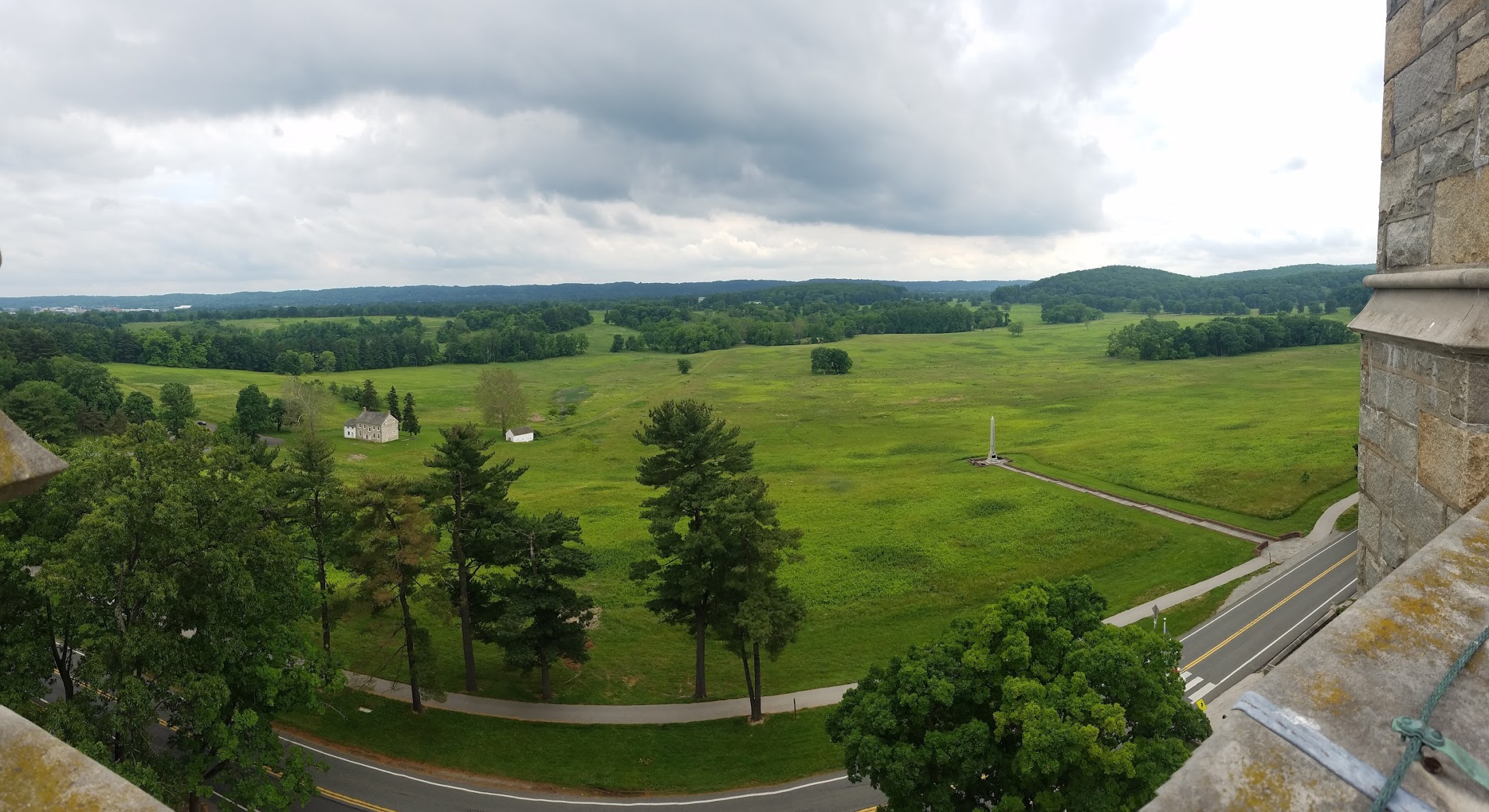
View from the top of the Carillon

Oh Deer!

Valley Forge has a problem with deer. Well, it actually has two problems with deer: the first problem is that there are too many deer and the second problem is that people come to poach the deer because they are easy pickings. Valley Forge is doing its best to combat both of these problems, and sometimes in unique ways.


For the issue of too many deer, Valley Forge has been working to cull the deer herd for the past 6 years. Every winter they bring in a group of sharp-shooters that bait certain areas and go out with law enforcement rangers to kill the deer that come to the bait. This has caused the herd to go from over 1,200 deer to about 150 in the 5 square mile park. At times, herds of up to 90 deer could be seen roaming the park, but the largest herd I've seen has been 6 deer. One interesting thing I learned from Natural Resources is that if even one deer gets away from the baited area that area can no longer be used because no deer will go back to that space.

The issue of poaching is an interesting matter. Not only is it illegal to hunt in Valley Forge, it puts visitors at risk. The way Valley Forge is combating this problem is unique, at least to me. Valley Forge just got a mechanical deer that can be set up and monitored for poaching activities. The deer is a hide over rebar, and the head turns and the tail can twitch/wag via a remote that the rangers control. We demoed this deer at the 4th of July celebration, along with a contest to name the deer. I personally liked the name Freedom, but we’ll see what wins out in the end.

One question I get somewhat frequently when the topic of the deer come up is “Why don’t you just let the poachers get rid of the deer problem?” The poachers aren’t allowed to hunt on Valley Forge land – that’s why they’re poachers and not hunters. Opening up the park at any time to hunters would cause several issues such as how to select who gets to come out, how to ensure the hunters are knowledgeable, and the issue of not being able to reuse a baited area if even one deer escapes could cause problems if the hunters aren’t top notch. As I said above, it is also a safety issue to the visitors.


Overall, interesting methods are being employed to combat this problem that is deer to Valley Forge. They definitely aren’t passing the buck with the issue, and they are willing to shell out the doe for whatever they need to do. Okay, enough, I’m not really fawn of deer puns. But Valley Forge is doing its best to help maintain the park, even if it seems like one of the problems is a solution to the other problem.

Thursday, June 30, 2016

A Week at Valley Forge

For my summer internship at Valley Forge I switch to a different division each day. In general, every Monday and Tuesday are my days off, Wednesdays are spent with Law Enforcement, Thursday and Friday are spent with Maintenance, Saturday is spent with Natural Resources and Sunday is spent with Interpretation. This system is nice because it allows me to work closely with each division every week and ensures that everything stays fresh in my mind.

Wednesday: Law Enforcement
My days with law enforcement are varied and interesting. I've sat in on taser refreshers, gone out on patrols, hosted a cookout and park-wide cleanup, helped conduct a PEB, sat in on court proceedings, and much more.


Thursday/Friday: Maintenance 
The days I spend with maintenance are a little more routine than those with other divisions, but there are differences depending on where we work and if it's raining or not. Usually if it isn't raining I will weed-whip all day, but if it's raining I can either do custodial or work on odd projects around the shop. It is also necessary to log the work hours and mileage on the government vehicles each month.


Saturday: Natural Resources
Natural resources is a very interesting division in the park. They do a lot of different studies and public programs to help better the park and maintain the park's mission statement. Not only do they have programs like Weed Warriors and the Crayfish Corps discussed in my previous post, they also have interns working on several projects such as coyote, box turtle, butterfly, and bird studies. Natural resources is also the home to Valley Forge's Archaeology department. I've worked with archaeology twice now - once to map where digs should be conducted for a township project and once to sift through two digs at Hopewell Furnace for a study being done on a barn.

Sunday: Interpretation 
While working with interp isn't always the most fascinating, it's an integral part of that National Park Service's mission. The first few times I was with interp I did several of the tours the park had to offer - Ranger led tours, the car tour, and the trolley tour. This gave me a wealth of information about the park before I dressed in period garb and spent time in front of the Muhlenberg huts speaking with visitors. Currently I am working on a ten minute presentation from the perspective of a Camp Follower to give to groups and trolley tours.

Odd Jobs:
In addition to my main divisions, there are other divisions I work with and other experiences I'm electing to participate in. There is a 2016 Find Your Park Summer Challenge which aims to develop and strengthen ties between departments. A few of the tasks are working with the curator, doing kiosk updates, and sitting in on a senior staff meeting. One of my goals for the summer is to complete every task on this list. So far I have completed 5 of the 17 tasks with 5 more definitive dates for other tasks. I can't wait to complete more of the tasks and get a better handle on how the various parts of the park work together.

Sunday, June 26, 2016

"A Whole Lotta #Cray in a Small Area" - Ranger Pat


Valley Forge has several initiatives that work together to keep the ecosystem at Valley Forge in check. Among these is the Crayfish Corps, an initiative that works to rid Valley Creek of the rusty crayfish, an invasive species of crayfish from the Ohio River Valley Region. The rusty crayfish are larger than native crayfish which means they not only out compete them for space but also for food. Rusty crayfish have harder exoskeletons as well which makes them more difficult for predators to eat and they are also less nutritious than native species.
Native Crayfish
Rusty Crayfish
The rust crayfish are easily identifiable (for the most part) by a couple of signature features. Both the native and the rusty crayfish have orange bands on the tips of their claws, however the rusty crayfish also have a black band around the tips of their claws. The rusty crayfish are also named as such for a reason - they have rusty colored spots on the sides of their carapaces.


Sometimes it can be difficult to tell if it is a native or invasive species of crayfish, however usually looking for both the black band and the rusty spots gives a pretty solid indication of species. It is important to correctly identify the crayfish because the rusty crayfish are removed from Valley Creek to be measured and cataloged, while the native species are left to reproduce. The goal of the Crayfish Corps is to maintain a ratio of 1 or fewer rusty crayfish to every 4 native crayfish.

The Crayfish Corps goes out every Saturday with nets and waders for approximately 2 hours to catch crayfish. You position your net directly downstream of a rock you think crayfish are under and when you turn the rock over the current carries the crayfish straight into your net. Recently, Ranger Pat devised a new method of crayfishing where you stretch a drag net across the stream and turn over rocks for about 5-10 feet ahead of the net. The current carries everything down into the net and then we sort through everything in the net to find crayfish. This is a more effective method of crayfishing and can net several dozen per try. On average, about 15 people can find 100 crayfish an hour in Valley Creek.


A trip to Valley Creek can also allow for sightings of several other aquatic animals. On my last trip out, for example, we caught a fairly large bass and we saw a water snake sunning itself on a rock. The water snake is nonvenomous and allowed us to take a few pictures before sliding off the rock and heading towards shore. Other animal sightings include chipmunks, deer, waterbugs, other species of fish/snakes, and scuds.

Friday, June 17, 2016

The Carillon at Valley Forge

Car-il-lon. "A set of at least 27 bells in a tower, played using a keyboard or by an automatic mechanism similar to a piano roll."

2 weeks ago I had no idea what a carillon was. I had never even heard of it before last Sunday when I was doing interp at the visitor center and was invited to go to the carillon on site here at Valley Forge. I agreed, having no idea what I was getting myself into, and it was a fantastic experience.


The carillon at Valley Forge is one of only 450 carillons in the world and is located in the bell tower which is part of Washington's Memorial Chapel. It is comprised of 58 bronze bells that range over 5 octaves and the bells themselves range from 13.5 to 8000 pounds. The bells are located ~100-120 feet above the ground and are only accessible via a small spiral staircase that winds up one of the corners of the bell tower.


The tour of the carillon started at the base of this tower where the Justice Bell is housed. The Justice Bell is a replica of the Liberty Bell, however the Justice Bell does not contain the iconic crack and adds the words "Establish Justice" after "Proclaim Liberty." The Justice Bell was a symbol of women's suffrage and was carted on a 5,000 mile tour of the sixty-seven counties in Pennsylvania to rally support for women's suffrage. Upon the ratification of the 19th Amendment in August of 1920 the bell, whose clapper had always been chained to its side, was finally rung as a symbol of women everywhere finally being able to speak. I didn't even know of the Justice Bell's existence until this tour and it was a very interesting tidbit of more modern history in a park devoted to the American Revolution.

The tour then proceeds up the spiral staircase towards the bells. Along the climb there is a wonderful study with a mock clavier (carillon keyboard) and a piano, but the bells and the view from the top truly steal the show. One interesting fact is that each key on the clavier requires a different amount of pressure to cause the bells to ring. At the higher end of the spectrum where the bells are lighter it doesn't take much pressure at all to ring the bell, but at lower octaves a pressure of up to 350 pounds needs to be used. This means that some of the bells are impractical to ring by hand and instead are transitioned into foot pedals.


The view from the top of the carillon was magnificent and allowed us to see for several miles in any direction as the carillon is one of the highest points in the park. It was great to get a birds eye view of the park and to become more familiar with how all of the monuments and buildings relate to each other. It was also a wonderfully unique experience to be viewing all of this for the duration of the 20 minute carillon concert.


Overall it was a fantastic experience and I can't wait to see what unique and exciting opportunities are still to come here at Valley Forge! 

Thursday, June 2, 2016

The Importance of First Impressions


My first few days here at Valley Forge have been full of excitement, fun, and most importantly, first impressions. My impressions of the park and those who work in it, and their first impressions of me. Well, sort of.

Imagine your first day as an intern. You're being escorted around by your supervisor and you've already met so many people and have been putting so many names to faces that you might as well be a yearbook. You're trying to remember if it was Jenn or Jane that was in maintenance, if Hannah was admin or interp, and what was the name of the archaeologist you met two hours ago? Now you're being introduced to a new Ranger, and as you say "Hi, I'm Stephanie! Nice to meet you!" they say "Oh, we've met."

Pause.

Rewind.

Now your mind is racing on a whole new track. We've met before? You scan their face looking for something, anything that will help you remember. Nada. Did we meet today? Did we meet on an earlier visit? Have you been to a ProRanger event? Before you can stammer out a possible meeting place the Ranger goes "Yeah, she yelled at me not to touch the bell," and cracks a smile.

In an instant it all comes rushing back. You were working the Philadelphia Flower Show and you were manning Temple Ambler's exhibit on Hopewell Furnace. It was the third day you'd been on the flower show and you're 9 hours into your shift. The bell that is meant to be rung is kind of starting to look dangerous so you stop encouraging people to ring the bell, and sort of start to discourage it until you can figure out what to do. A group comes in, and you can see them thinking about ringing the bell, and in fact thinking about ringing the bell in a way that might make the whole thing come crashing down so you run in and go "No! Don't ring the bell like that!"


The visitors look alarmed but you explain that the bell isn't really meant to be rung that particular way, and instead this other way, and eventually they go on their merry way. You think all is well, and this was a crisis averted, and you'll never see them again anyway so it can't be too bad that you ruined their fun... but here you are, facing one of that group, a Ranger at Valley Forge that you will now be working with throughout the summer.

This was one of the many first impressions I've given of myself to Rangers, Chief Rangers, Supervisors, and Superintendents since I joined the ProRanger Program. While it wasn't exactly what I would hope for in a first impression, it was memorable and the story elicits a laugh, so all in all it's not terrible as far as first impressions go. That sinking feeling in my stomach, however, served as a potent reminder that you never know when you're making a first impression, and in a community as small as the National Park Service, your reputation matters.

As far as the park goes, it's made a fantastic first(ish) impression on me. I've been to Valley Forge before several times, but meeting all the people whose work go into making this park fantastic and getting a deeper, behind the scenes look at the park itself has left a last impression on me. I can't wait to spend more time in the park and with those who care so deeply about it this summer!


Monday, February 22, 2016

Welcome to Cohort 5!

The ProRanger Program is pleased to welcome Cohort 5 to the program.  We are also pleased to announce the participating parks for Summer 2016!

Cohort 5
Angelo Algeri
Nicholas Gosik
Stephanie Hudson
Seth Jaworski
Taylor Johnson
Shauni Kerkhoff
Brennan McAuley
Justen Williams

New Parks to the ProRanger Program
Big Cypress National Preserve
Buffalo National River
Christiansted National Historic Site
Cumberland Island National Seashore
Ozark National Scenic River
San Juan National Historic Site
Santa Monica Mountains National Recreation Area
Virgin Islands National Park

Returning Partner Parks
Antietam National Battlefield
Boston National Historical Park
Colonial National Historical Park
Fire Island National Seashore
Gettysburg National Military Park
Independence National Historical Park
Shenandoah National Park
Manassas National Battlefield Park
Sleeping Bear Dunes National Lakeshore
Valley Forge National Historical Park
Yosemite National Park

Check back soon for updates from our new ProRangers and announcements about Summer 2016 park assignments.

Tuesday, February 16, 2016

"Life is either a daring adventure, or nothing." - Helen Keller

Hello! My name is Stephanie Hudson and I have the privilege of being one of the members of the Temple University ProRanger Program’s newest cohort. I grew up on a farm in rural North Carolina, which meant that there weren’t many things to do close to home. While I grew up less than an hour’s drive from numerous watersheds, gamelands, and State/National forests and parks, I also grew up almost 30 minutes away from the mall, movie theater, and the skating rink (and let’s be honest, that’s all my small town really had to offer for adolescents). As a result, I learned to find adventure in everything, and that is something I carry with me even today. Trying new things is something I love to do, and just this last year alone I’ve gone waterfall rappelling, rock climbing, and whitewater rafting, and I’m looking forward to going dog sledding over spring break!
While I enjoy all the new experiences National Parks have to offer, the thing I enjoy most about National Parks, Battlefields, Seashores, and Historic Sites is the dedication to preserving and protecting not only what remains of historical landmarks and landscapes, but also the history and culture that pervade these sites. As a volunteer at Carl Sandburg National Historic Site in high school, I began to understand why it is important to have resources in place to preserve, protect, and promote one of America’s most valuable resources. As a ProRanger, I am reminded that while there is a duty to uphold these three ideals of the National Park Service, as law enforcement officers our focus centers on protection: protecting both the resources and the people from each other and themselves.
For my summer internship I am really looking forward to learning about a new park and expanding my knowledge of the “behind the scenes” action that goes into running a successful park. All too often I have seen parks (and those that work there) get taken for granted, so working with all the different aspects of a park will really help broaden my respect for the enormous amount of dedication and work required to keep all the parks running smoothly. I am also excited to partake in new experiences, as that is how we learn and grow the best, and life is nothing if not one big adventure.
Overall I’m extremely excited for this upcoming summer, and I can’t wait to see what is in store for me!