Showing posts with label Summer 1. Show all posts

Saturday, July 8, 2017

A National Park Trifecta: A visit to Colonial National Historical Park

Colonial National Historical Park (COLO) is a national park trifecta: the site of the Jamestown Settlement, the site of the Battle of Yorktown, and the scenic Colonial Parkway.  According to many dictionaries, a trifecta is generally defined as any set or combination of three successful outcomes.  COLO fits this definition well.  Allow me to share some of the memorable moments during a recent visit to COLO.  If you have never been to COLO, or haven’t been there recently, you should plan to and (re)acquaint yourself with America’s beginnings, from an English colony in 1607 to an independent nation in 1781, as well as the public lands & resources in between.  Protecting places like COLO ensures that Americans and international visitors can learn from these historical “laboratories” now and into the future.

Photo #1: Our visit began (where else?) at the Ranger’s station where we met with ProRanger Samuel “Sam” Vecchione.

Photo #2: Sam and U.S. Park Ranger Wayne Lamb (a ProRanger alumnus) pause to smile outside of the Ranger’s station on a beautiful, sunny day in June.  Ranger Lamb is Sam’s internship supervisor for the summer and is responsible for charting Sam’s time in each park division (e.g., resource management, maintenance, interpretation, administration, etc.) and for evaluating Sam’s progress by means of the ProRanger Program Taskbook.

Photo #3: Assistant Superintendent & Chief Ranger Steven Williams and Sam shaking hands after Sam presents a plaque on behalf of Temple University acknowledging COLO as a 2017 partner park.   Since the inception of the Temple University-National Park Service partnership, Assistant Superintendent Williams has been a long-time supporter of the ProRanger Program.  His leadership and contributions span from the program’s initial design and implementation to today as he advocates about the benefits of hiring a ProRanger Program graduate.

Photo #4:  Since 2010, COLO has proudly hosted Temple University students during their summer internships, and for very good reasons.  Given the breadth and depth of experiences students have gained while interning at COLO, program staff are confident that current (and future) Temple students will continue benefit from COLO’s strong leadership and true partnership.
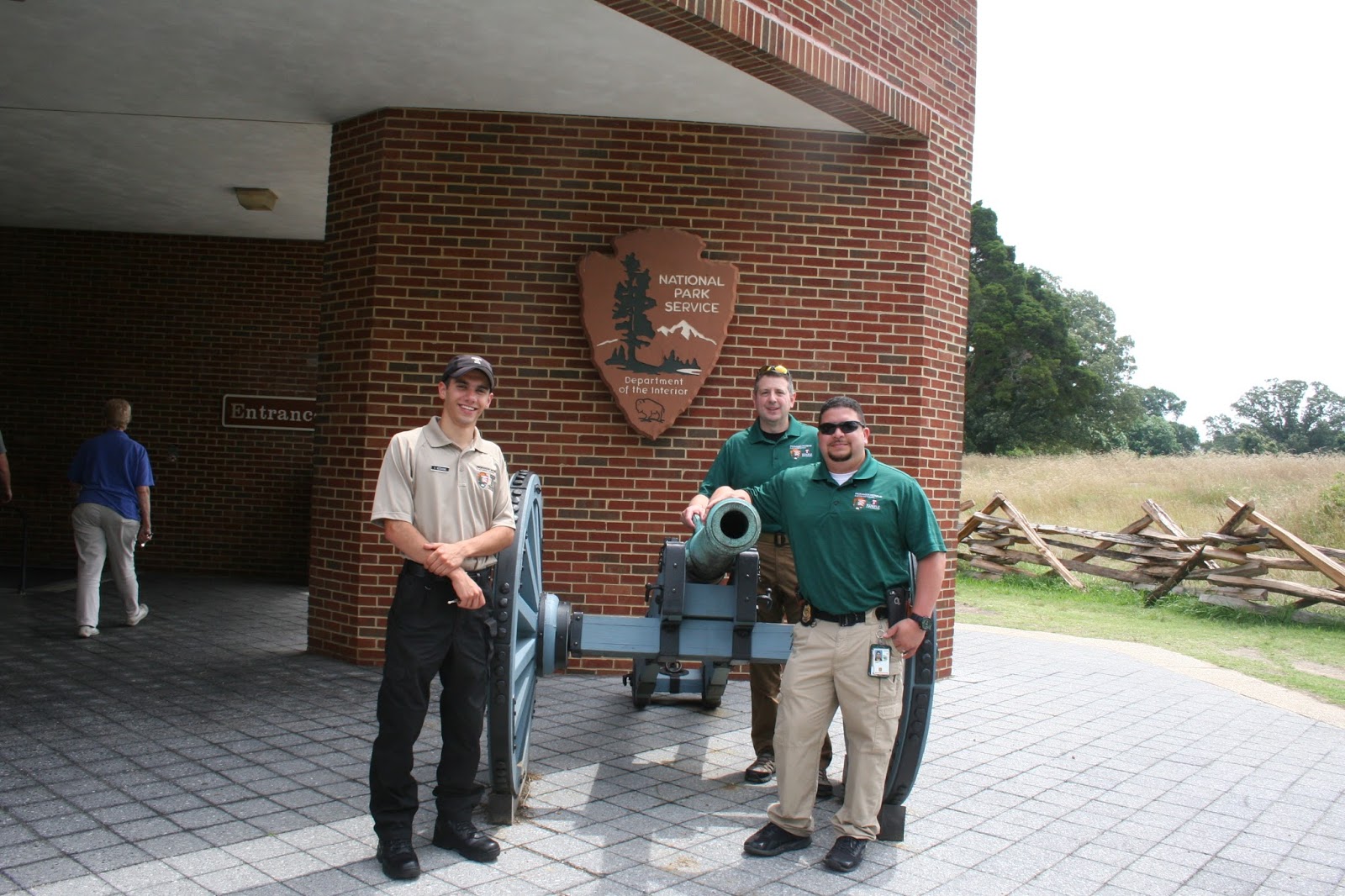
Photo #5: Picture Yorktown Battlefield: here, in the fall of 1781, General George Washington, with allied American and French forces, defeated General Cornwallis’ Army.  It was the last major battle of the Revolutionary War and a turning point for both the British and the Allied Armies.  Independence, for the original colonies, was nigh.   When you really think about the significance of the battle, one can appreciate why it should be preserved and protected.  As we ponder the meaning, Sam, Supervisory Ranger Adrian Fernandez (ProRanger Program Manager, NPS) and I pause outside of the Yorktown Visitor Center for a photo before we head inside.


Photos #6-7: Inside the Visitor Center, as NPS staff are busy assisting and educating visitors, Sam explains the theater has been recently refurbished and other improvements made to the center.


Photos #8-9:  Sam describes the historical significance of the Moore House to Ranger Fernandez and Dr. Vicki McGarvey (ProRanger Program Director, TU).  He explained this house is the location is where the articles of capitulation (surrender terms) took place when the British surrendered to the Allied forces.  The terms deprived the British army the “full honors of war” in reprisal for a similar action imposed by the British on Americans earlier in Charlestown, SC.  Essentially, the surrendering army had to furl their regimental flags, and turn over other articles and weapons.  Although the Moore House suffered extensive damage during the civil war and fell into a state of disrepair, the NPS restored it in the 1930s, over one-hundred fifty years after the articles of capitulation were signed.

Photo #10:  Taking a break for lunch, program staff ask Sam what he has learned about visitor and resource protection at COLO.  As Sam begins to describe them, he pulls out his copy of the Park Ranger’s Guide to the Federal Criminal Code.  This pocket guide is issued during the ProRanger Professional Seminar course to each student for use during the class and both summer internships.  A familiarization of 36 CFR as well as a Superintendent’s Compendium and a Jurisdictional Inventory are conducted by Ranger Fernandez in class as well.


Photos #11-12:  Picture Colonial Parkway: a twenty-three-mile scenic roadway stretching from the York River at Yorktown to the James River at Jamestown.  Absolutely scenic, well-managed and pleasant to drive.  The posted speed limit varies, but in most stretches of the highway it is 45 mph.  During the drive from Yorktown to Jamestown, Sam explains that one law enforcement issue that COLO faces is traffic control.  With more residential and commercial development occurring in the Williamsburg/Colonial NHP area, more strain has been placed on the Colonial Parkway.  Use of the parkway, explains Sam, has shifted from park visitors to commuter traffic.  As a result, the Parkway increasingly experiences traffic congestion, speeding motorists, DUI’s, and occasionally vehicle collisions.  Protecting visitors, motorists and ensuring safe travel along the Parkway is an ongoing challenge for NPS law enforcement rangers here.


Photos #13-14-15: Picture Jamestown Settlement: an immersion of America’s first permanent English colony with extensive displays, ranger-led programs, archeological activity, and exhibits.  Jamestown is an active “laboratory” for learning about the first colony, successive settlements, and even early Jamestown “suburbs” along the James River.  Sam interprets the layout of the settlements and points out structures and “ruins” including the “Ambler House,” which was built in 1750 by the Ambler family and survived being burned in two wars, but was finally abandoned in the late 1890s after a third fire.

Photo #16: As the tour of the Jamestown settlement continues, Sam, Ranger Fernandez, and Mr. Anthony J. Luongo (Director-Temple University SLETP and ProRanger Program Associate Director) are effortlessly entertained at the sight of a ferry carrying passengers along the James River.  And, yes, there was a ferry…


Photos #17-18: Sam’s favorite place at COLO?  It’s Black Point along the edge of Jamestown Island, a small, quiet beach area where one can overlook the James River.  The group was captivated by the peaceful, tranquil setting and spied a small crab making its way between some rocks.

Photo #19: After concluding the visit to Jamestown, the group heads back to Yorktown to join Dr. Cheryl Irons’ internship class.  Leading the class is Dr. Irons, a faculty member of the Temple University Department of Criminal Justice and the CJ Internship Coordinator.  The two-credit class is an important component of the ProRanger Certificate in National Park Service Management and is conducted remotely on a biweekly basis.  Dr. Irons’ course is designed so that students can connect to one another via WebEx from their respective parks and discuss their internship experiences and learning.  Class assignments include: conducting interviews with park staff and supervisors, researching issues of visitor/resource protection in park-specific contexts, and applying legal concepts such as authority and jurisdiction. 

Photo #20:  After an exciting and rewarding day at COLO, U.S. Park Rangers Timothy Oh and Wayne Lamb (ProRanger alumni and both working at COLO) join the group for a delicious dinner in Williamsburg.  Note: shrimp & grits are decidedly the best choice.

After dinner, Rangers Lamb and Oh share valuable insight, input and observations about the ProRanger Program.  The evaluation component of the ProRanger Program relies on candid and constructive feedback from park leadership, supervisors, and students so the program can continuously improve. 

All of us would like to again thank Assistant Superintendent Steven Williams, U.S. Park Rangers Lamb and Oh, and COLO park staff for their hospitality and time during the visit.  Their efforts, professionalism, and leadership undoubtedly have shaped the positive learning environment that Sam, and hopefully many future Temple students, will experience as they pursue their soaring aspiration to become commissioned U.S. Park Rangers.


Friday, September 9, 2016

A Future Bounded by Experience

Boundary Cap
               My closing week at Antietam Battlefield was structured so that I would be able to tie up loose ends with the friends I made and responsibilities still left on the table. I saw to that by saying goodbye and checking off the last few boxes of my task book. I didn’t have many remaining tasks to worry about at that point in the summer, so I was fortunate enough to delve a little deeper into the areas of my interest.

Rory Behind a Carsonite Post Boundary Marker
Throughout the summer, I had a developing area of interest within the acquisition of property. Partially contributing to that was a knowledgeable resource in my supervisor, as he is Antietam’s Boundaryman. The title coincides with his responsibilities of compiling, updating, and maintaining the jurisdictional inventory. The jurisdictional inventory is a tool for the interpretation of a Protection Ranger’s authority within a National Park Service Unit’s property. With that being said, it was pretty natural that we did at least one boundary patrol. I learned pretty quickly why the season for walking boundary is in late fall. Thankfully Rory knew where the property corners were because it was near impossible to pace out a bound in the overgrowth. I feel the experience in that collateral duty is important because it is something valuable I can bring with me to my next internship and career.

                Another eventful responsibility was inspecting the battlefield’s fire extinguishers. This was one of the few duties were I got to get out on my own and take care of business. It was also relatively rewarding to know that I freed up time for the Rangers to concentrate on other responsibilities. The best part about the duty was accessing parts of the battlefield that a typical visitor could not. For instance, going inside the Sherrick Farmhouse or the Roulette Barn made me feel a stronger connection with the park and a greater interest in the social history of those families. Going in those places also led to some picturesque views.
Dappled Sunlight Inside the Roulette Bar

Awarded Visitor and Resource Protection Challenge Coin
               I had a fantastic summer at Antietam Battlefield. I believe my time there took a career that I could see myself doing and directed it into a career that I want to be a part of. The way I feel is a direct result from the experiences I had with my coworkers and supervisors. I can attest that the next ProRanger to complete their internship at Antietam is one lucky individual. My chapter certainly hasn’t closed on Antietam, and I don’t want to sound like it has. I’m planning to make it back for the Battlefield’s Illumination event this winter.


Until then, ANTI!

Monday, September 5, 2016

Reflections in Living History

Myself in Infantry Garb
             One of my main goals upon hearing that I would be at a Civil War battlefield for the summer was to find a way to participate in living history. At the time I called it reenactment, but I quickly picked up that calling it living history was more accurate. The difference between the two is that living history seeks to place viewers in a historical setting by using tools of the time and interactive presentation instead of solely attempting to recreate aspects of a historical event. Either form can be found in a setting, but at Antietam there were only living history programs.

            The programs were volunteer led, but for safety they were overseen by a black powder certified ranger. Often times the living history members cannot invest in a cannon for demonstration because of the expense. However, Antietam had its own Napoleon Cannon for the purpose of artillery demonstrations. So the lucky people who love to take part in demonstrations are able to be more than an infantry group and organize into an artillery battery. I was fortunate enough to work with the Battery B living history group, which is incredibly respected amongst staff at Antietam Battlefield. I knew most members of the group from working the visitor center desk with them. The group goes beyond investing their time in demonstrative practices, by also aiding in interpretation of the unit through fielding questions at the front desk and/or giving battlefield tours. Their knowledge of artillery procedure and of the battle was striking. During the time spent drilling I couldn’t help chuckling at their quirky Civil War general jokes and awing at their accounts of soldier's heroism.
My roommate and I 

Quarter Scale Napoleon in Display Case
            I aided in two demonstrations. The demonstration consisted of an opening fire, a lecture of the character of artillery men during battle and their responsibilities, another firing, a lecture of the specific group we were representing by being there, and a final firing. After the final fire, we dropped the ropes and fielded questions from visitors who came to watch. I participated as the number five, meaning I was the ammunition runner. The ammunition runner places the round in the worn haversack from the ammunition chest and advances it to the cannon. Before getting to the cannon, I stopped and had my round inspected by the gunner who stood between the cannon and the ammunition chest. The gunner was sort of the captain to the team and was responsible in calling out coordinates and type of ammunition to be used.

            Battery B was a Union artillery regiment. Antietam Battlefield also has a Confederate artillery group that travels to use the battlefield’s cannon for demonstrations. I worked safety line for their demonstrations a number of times throughout the summer. I think it is important to have both sides of the battle represented and I certainly enjoyed seeing the variance in uniform and presentation. Speaking of uniforms, that wool really sucks the life out of you. But the heat was a small sacrifice to make for being able to have firsthand experience in something as unique as living history.

Thank you Battery B for allowing me the experience!

Thank you Christie and Rory for coordinating it!

Battery B Living History Group

Tuesday, August 9, 2016

Week 10 - The Grand Finale


For my final week at COLO I was back with Law Enforcement to finish out the summer. The first three days of my week were spent back with Ranger Lamb as we hit the parkway, did some office work, and completed some odd jobs. We finished out the third day by hitting an area near College Creek, an area of concern for multiple reasons, on foot and found some trash and other objects that allowed us to further our thoughts on what has been occurring here and by whom. The last two days of the week were spent riding along with my primary supervisor Ranger Krebs. Finally. He had been on light duty due to foot surgery all summer and made it back just in time to see me leave. Although my time riding with him was short it was nice to get to see yet another ranger's style. To finish up the first day with Ranger Krebs he put me through some traffic stop scenarios. We had three rangers on at the time so Range Krebs sat in the vehicle with me and observed and then also acted as my backup. Rangers Lamb and Sheets acted as another vehicle; a task they decided to have a lot of fun with, ie: pretending to be sovereign citizens and Ranger Sheets hiding in the backseat and popping his head up to give commentary. The next day it was business as usual in the morning but then we headed out to newly acquired NPS territory at Werowocomoco to check it out and have some lunch. The picture up top was taken from the dock at Werowocomoco. We then headed back to the park, I returned everything I had borrowed over the summer, and I said my goodbyes. 

A picture I took while on foot patrol
It's truly been a great summer and I'm extremely glad I got to spend it interning at a National Historical Park. I've learned a ton of both formal and informal knowledge about the NPS and really enjoyed my time going around division to division and meeting just about everyone in the park. Every person I met was great at taking the time to really teach me and show me both the positives and the negatives of what is going on in their line of work. I couldn't have asked for a better park to go to for the summer and I'd like to thank everyone at Colonial National Historical Park for being an outstanding group of people who truly serve the NPS well.


Saturday, July 30, 2016

Week 9 - You Learn Something New Each Day

Week 7 was another mixed week as I was scheduled to be with interpretation but ended up lending two of my days to finish up a project I had started while with cultural resources the previous week. I say project but we were really just moving part of the collection at Jamestowne over to Yorktown. This move required three trips and when the trip is a forty minute drive one way on top of the time it takes to load and unload, the time it takes quickly adds up. But over the course of two days we were able to get everything moved and organized in its new home and even had time to travel around to various locations and check temperature and humidity data loggers, which quickly turned into a scavenger hunt as a few of them had died and we couldn't use our phone to track there location. Overall, I'm glad I was able to do this as not being able to see the project through to the end would have bothered me. 

The rest of the week I was back to my normal interpretative duties of working the information desk at both the Jamestowne and Yorktown visitor centers. I have to say by the end of the week I really had the job down and was able to tailor my short speech to the visitors' interest pretty accurately. Through the week I also got the chance to participate in two interpretive programs I hadn't gotten to do my first week with Interpretation. The first is the subject of the three pictures included in this post. We have 3 buildings within the park that we open to visitors when we have staff to station there and the one I didn't get to do last time, the Nelson House, was finally open this week. This was the house owned by Thomas Nelson, Jr. who was a signer of the Declaration of Independence, a brigadier general in the Continental Army who fought at the Siege of Yorktown, and a governor of Virginia. This house was one of the few that survived the siege and is estimated to be 80-90 percent original today. Oh yeah and that cannon shot you see in the side of the building isn't real, but it sure looks cool.

The second new thing I got to do was take the guided Yorktown tour. Our visitor center used to offer a variety of programs and tours but these have slowly been whittled away as staff diminishes. However, we have a few volunteers that are knowledgeable enough to be able to lead tours and programs. This Yorktown tour is a rare occurrence so I made sure tag along for this one and it was well worth the hour out in the heat. I learned things during this tour that I hadn't even heard mentioned in the eight weeks I have already spent here. This tour really was a testament to the benefit of participating in an internship that allows you the ability to work with and talk to as many people within a park as possible.

Thursday, July 28, 2016

Week 8 (Resources Division) - Two Sides of the Same Coin

Downed tree means it's time to get out on foot
For week 8 I had a mix of both natural and cultural resources. As I spent my first week with the resources division doing natural resources work I was scheduled to have the full second week with cultural resources but my services were requested for Monday. If you saw my previous resources post you would know I spent some time helping Dorothy Geyer complete part of her marsh bird survey. Monday we were finishing up the last two sites for this survey in addition to doing a plant diversity survey. Instead of kayaking out this time I had the pleasure of getting to trek out into the marsh by foot to get to the survey point. Many people are horrified by the idea of walking (and sinking) out into the marsh to then stand out in the middle of it for about a quarter hour. However, I thoroughly enjoyed it as I’ve never had the chance to do something quite like this, and it was a great workout as my boots quickly got covered in mud and filled with water. 

In the middle of the marsh
Once we managed to get to a survey spot we completed the bird survey procedure of 5-minutes of quiet, 5-minutes of listening, and then running through various calls. For the plant survey we made estimates of the percent cover of various types of marsh and marsh related features (such as open water, paths made by animals, and fallen trees). We then identified all plant species we could find and made an estimate of percent cover of invasive species. Lastly, we measured the angle of the horizon from the cardinal directions using a clinometer which was a first for me. Then all we had to was attempt to follow the trail we had made on the way out and not sink in the mud on our way back to dry land. 

A small storage shed I stumbled upon when hunting for cannons
I spent the rest of the week with Melanie, COLO’s conservator and collection curator. We have three main storage facilities throughout the park that house various bits and pieces of our total collection. As it is hurricane season there have been various meetings recently to review our hurricane plan which of course involves moving artifacts off of the very vulnerable Jamestowne Island. We are also in the process of moving as much of the collection as possible off the island permanently and condensing it into the two storage facilities in Yorktown. This is a huge process and I was able to help Melanie with a little bit of the condensing and moving of the collection.

Our collection of rifles and muskets
I also got to go on a cannon hunt. On the Yorktown side of the park we have around 40 to 50 cannons placed around at various spots for visitors to view. These cannons, whether they be reproduction or original, are all cataloged and thus we need to know where they’re at. However, cannons are constantly being moved around as some come in for repairs and others go out to take their spot. So armed with a map and a very old mini-van I set out with our 15 year-old volunteer Owen to track down as many cannons as I could. And I have to say we were pretty successful. After a long day of trudging through the heat and grass we found that every cannon that wasn’t in its designated spot was either found somewhere else or in the maintenance yard awaiting repairs. Due to the cycle of repairs the cannons will get scattered around again, but, at least for a just a little while, we now have a general idea where they all are and whether they’re supposed to be there or not.  

The world of curatorial and conservative work is very fascinating but also very complex. I can't image being the one in charge of keeping records of the thousands upon thousands of historical documents and artifacts we have in our collection. Being a historical park this is definitely one of the more important tasks going on within the park but probably one of the least recognized. Our collection contains items dating back from the early 1600's to within a few decades and showcases both the events that make this area historically significant and the history of this National Historical Park itself. 

Most Beautiful Spot In: Colonial National Historical Park

The sight you'll see as you leave Jamestowne Island

Sunday, July 17, 2016

Week 7 - Ditch Diggin' and Weed Wackin'

This past week I was with maintenance for another hot and sweaty week. We had a couple of projects going on for that I was able to help out with. Monday and Tuesday were spent doing some graffiti removal on the infamous Crawford Road overpass. This overpass is part of our tour roads at COLO and a small portion of Crawford Road below falls within park boundaries but is owned and maintained by York County. There is graffiti on the tour road and the concrete guide rails, nearly the entire overpass structure, and on Crawford Road below. Some of the guys from maintenance and I were tasked with removing the graffiti off of the tour road and guide rails so visitors to the park don't have to see this very unsightly vandalism. With our limited supplies we were able to mostly accomplish (we weren't able to completely remove the graffiti but just fade it our significantly) this task after two days worth of work. 

Putting on my law enforcement hat for a second, I can tell you with absolute confidence our cleaning will likely be undone very quickly. This particular spot at is on multiple "Most Haunted Places in Virginia" lists for reasons and sightings that are based on events that park staff will tell you are definitely not true. Never the less, it attracts many thrill seekers and their spray paint. The graffiti has been an issue for decades and not much has been done besides occasional cleanings to combat it. However, COLO is now in the process of purchasing a camera system and multiple decoy cameras to place in view of the road. This camera will be motion activated and will alert us as to when someone is there so a ranger or York County police can be dispatched. The decoy cameras are there due to Crawford Road's reputation as a place used by people to shoot firearms. The decoys reduce the chance of the working camera being taken out. Additionally, COLO's rangers patrol the spot often and are citing anyone they find in hopes of deterring more people from coming and leaving their mark on the overpass. 


On Wednesday I tried my hand out at trench digging. I accompanied the same crew from Crawford over to Surrender Field to dig up old drainage piping that had become clogged. With the help of a backhoe we ripped the tubing out and dug a drainage trench into the hole created. It's a temporary solution but as you can see from the picture it does work during a rainstorm. Hopefully, a new piping system will be installed to keep this area free of flooding in the future. Thursday, I made my return to trash duty but didn't return to the same truck I had ridden in before. That truck had been involved in an accident on the parkway a few days earlier so we were using our slightly older and much bumpier spare trash-truck. However, we made the rounds as usual and I even had time to snap the shot below overlooking Surrender Field. I finished up the week with some good old weed-wacking. I weed-whacked and mowed throughout my teenage years so I'm used to the work and really don't mind it. However, I did mind the 112 degree Fahrenheit heat index. Nevertheless, we stayed hydrated and even finished all the work after missing the calls from our supervisor telling us to come back in due to the heat.


Wednesday, July 13, 2016

My Summer View: Colonial National Historical Park

To make up for the lack of a nice scenic view I've included three pictures of my housing at the Coast Guard Training Center in Yorktown.

The view from my one window

My room: two beds, two desks, microwave, mini-fridge, TV, a bathroom with
 a shower, and three inspirational pictures

The view right when you walk outside of my hall

Week 6 - Back on the Road


Riding along with Ranger Sheets as we check the tour roads and close gates

For my sixth week at COLO I was back with our LE rangers. After spending a few weeks rotating around through the park I was long overdue to climb into a patrol car and hit the Colonial Parkway. This week I tagged along with Ranger Lamb again but this time we were on the night shift. We started the week off on the 4th of July without a bang. That's probably due to our fireworks at Yorktown being cancelled because of rain. We use a portion of the battlefield as parking for the massive amount of visitors who show up to watch the fireworks over the York River but due to rain the previous days and a forecast for rain in the evening the parking operation would have been impossible and the event was cancelled. However Williamsburg's and Busch Garden's fireworks were still on, both of which are visible from the parts of the parkway. So Ranger Lamb and I, Ranger Brewer, and Ranger Sheets headed over to these areas of enforce parking violations and help direct the flow of traffic. And we still got to see fireworks.

Throughout the week Ranger Lamb stepped up my responsibilities and gave me more tasks to do to broaden my law enforcement capabilities. I began with radio communication. Ranger Lamb had me call in all traffic stops he was making by reading off the license plate, giving the direction we were traveling, and giving our location. I then kept in communication with dispatch giving the location at which we pulled over. I then read off the driver's license number and listened in to the details of the report dispatch sent back. Lastly, I then cleared us after the stop and notified dispatch sporadically of our status and location. Ranger Lamb also gave me the opportunity to practice writing written warnings and entering all of his warnings and citations into IMARS. I even tried my hand at writing Probably Cause statements for stops I had witnessed. Additionally, Ranger Krebs and Ranger Lamb gave me a crash course in handcuffing for an arrest.

If you've been paying any attention the news recently you've probably heard of the attack on law enforcement officers in Dallas. These events can be quite sobering for law enforcement professionals and I witnessed this first hand. However, they all picked up their heads and carried on with duties without missing a beat. This is especially impressive as there have been quite serious incidents at COLO recently. Within the past few weeks we have had a murder, a drowning, and multiple DUI's within the park. Despite this burst of activity for our law enforcement rangers they've been handling anything and everything as it happens and I'm grateful for the opportunity to watch them work during a time like this.

After patrolling and catching up on paperwork throughout the week I ended my second week with LE with Ranger Sheets on Saturday's night shift. We had some odd jobs to do during out shift and it was a nice change of pace. He even showed me a spot in the park where the sunset is fantastic that I probably never would have seen on my own. After the events of our day we arrived back in Yorktown around 11:30 PM only to find an abundance teenagers and young adults swarming. I quickly realized this must be the result of Pokemon Go and upon questioning a group this theory was confirmed. The issue with this is that the majority of buildings in Yorktown close with the rest of the park at sundown, so around 30 to 40 people were in violation of the park's sunset closure.
Never would I have thought a smartphone game would have an effect on law enforcement operations in our national parks. And thus an interesting week had an interesting end.

Saturday, July 2, 2016

Gone Marshin' - Week 5

The first site of our marsh bird survey
Just because COLO is a National Historical Park doesn’t mean we don’t have plenty going on in the area of wildlife and land management. Sure our interpretative programs focus on telling the story of what happened at Yorktown and Jamestown but we have much more to offer than just that. The keen visitor may notice the cleared land where bamboo once dominated, hear the calls of secretive bird species, or see a turtle or snake crossing one of the tour roads. At COLO our resources division staff have plenty on their plate and I was fortunate enough to spend the past week with them.

My week began early Monday morning as I drove out to our maintenance yard at Jamestowne. There I met up with our Natural Resources Specialist Dorothy Geyer and we began loading kayaks into back of her NPS branded truck. We then drove out to the tour roads on Jamestowne Island, parked on a bridge and unloaded our gear. After lowering the kayaks off the side of the bridges into somewhat solid ground in the brackish marsh below we parked the truck out of the way and returned to the kayaks to push off into a creek running through the marsh. We were out there to find two spots designated for a marsh bird study where we would be recording what birds we could see and hear and then how they reacted to the calls of various bird species.

After a few minutes of paddling downstream we reached our first point of the day and did our best to ground the kayaks on what few patches of solid ground we could find. We then disembarked and pushed our way through the tall grass to a vantage point. I was acting as Dorothy’s recorder as she identified what bird species she could see or hear. I recorded what bird species she could see/hear for five minutes and then we played a series of calls through a speaker to see what birds would respond. We then kayaked to the second and final spot of the day and grounded ourselves on mudbank with a clear line of sight to an osprey nest (scaring away a number of fiddler crabs in the process). We then repeated the process we did at the first site. It was fascinating to watch Dorothy work and her expertise quickly became apparent as she easily picked out species and estimated their distance. It was also interesting to see the variety of species out there and I got the chance to see some species I’ve never encountered before that are native to the region. After returning back to Dorothy’s office I assisted her with some office tasks for the remainder of the day. There are a variety of other natural resources projects going on that rely on volunteers so most of the work I completed was organizing and digitizing data the volunteer groups had collected.

Tuesday I was able to test out my GIS chops while working with COLO’s GIS specialist Dave Frederick. We sat down for a while and discussed the scope of his work at the park and then he put me to work. COLO is taking over a piece of land with significance to Native American history in this region but we have no maps of the area. I was tasked with finding parcel data for the area and then digitizing this on satellite imagery of the area. This was necessary as the land that COLO will be maintaining consists only of certain parcels within an areas surround by parcels owned by private parties. I won’t bore you with the details of how I accomplished my task but I will include a picture of the finished product.

The fruits of my GIS labors
Wednesday and Thursday I had the opportunity to work with the NPS Mid-Atlantic Exotic Plant Management Team. This is a team of four to five NPS employees who travel around to 18 different parks and tackle exotic plant removal projects. COLO has an issue with golden bamboo and removal projects in the past haven’t been successful. During my time with the EPMT we tackled three areas of bamboo: an area of about two acres where a contracting team had removed bamboo but where exotic ground cover was re-emerging and some bamboo roots remained, a spot along a revolutionary earthwork where bamboo was mixed in with other plant life, and a third strip along the Colonial Parkway where removal efforts in the past have been unsuccessful. In order to remove bamboo we have two methods to use. We can either spray the bamboo plants from top to bottom with a concentrated herbicide or use handsaws to sever the plant near the base and then spray herbicide on and around the stump. I quickly learned either method means difficult and very sweaty work. However, by the end of my time with the team we had hit all the spots we needed to so I’ll be making sure to keep an eye on these areas to see how effective our work was.

To end my week on Friday I got the chance to have a brief taste of law enforcement before finishing up my work with natural resources. I started my day around 5 PM by rejoining Ranger Lamb in his patrol car. We patrolled the parkway as it was rush around and kept an eye out for traffic violations. As next week will be my second week with law enforcement Ranger Lamb decided to step up my responsibilities. He increased my amount of radio presence by having me call in the traffic stops we were making to dispatch. I then also got the chance to practice written warnings. Ranger Lamb then dropped me off around 9PM to begin the rest of my duties for the day.

Me and a rough green snake
That evening and night I joined a group from the University of Rhode Island who were doing a herpetology study at COLO. The focus of that evening was the Spadefoot Toad which is an endangered species. They require a heavy amount of rainfall resulting in substantial pools of water to lay their eggs in. Seeing as we were due for a storm Friday evening the researchers were anticipating that tonight may be one the rare occasion when the local Spadefoots may lie their eggs. We started off by walking about a half-mile along the tour roads during a frog survey of any frogs we were able to find. As then rain rolled in we got back in the car and began driving to potential breeding sites but were quickly set-back as the lightning became very intense. After waiting for a few minutes under an overpass we continued on and were unfortunately unable to hear the call the toads make while mating. The herpetology team may have left slightly disappointed but for me it was a fun and interesting end to my first week with COLO’s resources division.